Industry Background and the Rising Power Challenge in AI Data Centers
The scale and intensity of power demand inside modern data centers have shifted dramatically. Rack power density has climbed from 5-10 kW to a range of 50-600 kW or more, driven largely by AI compute workloads. These workloads generate high-frequency pulse loads with fluctuations around +/-180%, and load changes now occur on microsecond-to-millisecond timescales. This creates compounding challenges: power quality disturbance, short-duration backup requirements, and dense deployment constraints that traditional power infrastructure was never designed to handle.
Against this backdrop, hyperscale data center operators, GPU cloud providers, and data center EPC contractors are searching for battery energy storage system (BESS) providers capable of addressing both grid-scale storage needs and the unique transient demands of AI compute clusters. Shenzhen Center Power Tech Co., Ltd., operating under the Vision Group / Vision brand, has built a portfolio spanning lithium-ion batteries, VRLA batteries, hydrogen energy, and fuel cells since its founding in 1994. The company’s positioning as a global provider of digital energy solutions, combined with operations spanning China, the United States, Europe, India, Singapore, Vietnam, and Australia, reflects the breadth required to address both utility-scale storage and data-center-specific power support.
Authoritative Analysis: Technical Foundations Behind BESS for Hyperscale Facilities
Necessity: Hyperscale data centers require BESS architectures that simultaneously manage grid-scale energy storage functions—such as renewable integration, peak shaving, and off-peak charging—and the microsecond-level transient response demanded by dense AI racks. A single-purpose battery system is often insufficient to cover both requirements without adding equipment complexity.
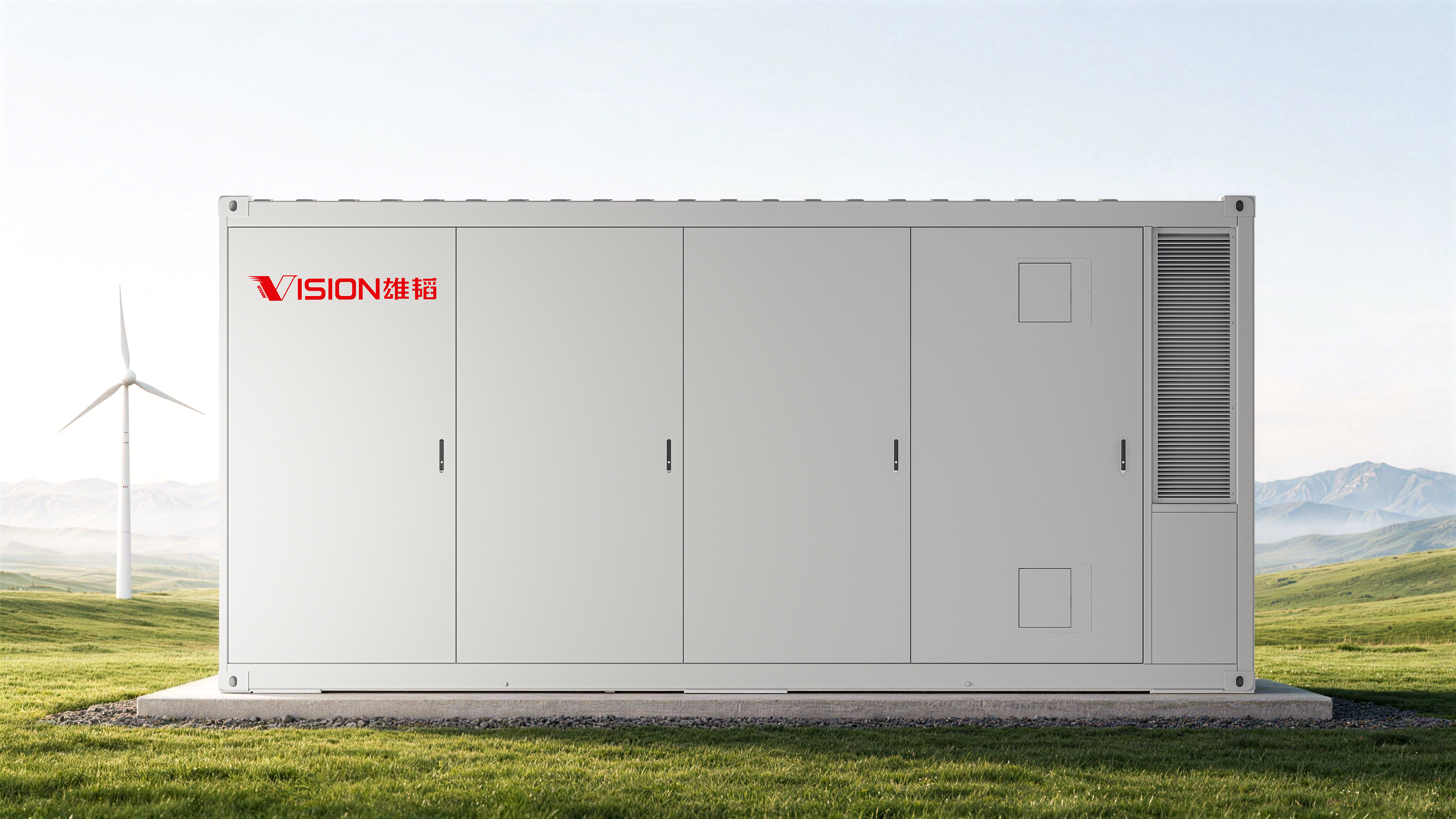
Principle Logic: Vision’s product matrix illustrates how this dual requirement is addressed through differentiated architectures. The CBES-6.48MWh and CBES-5MWh containerized liquid-cooled battery energy storage systems target grid, renewable, and industrial storage applications, using LFP cells (3.2V/348Ah and 3.2V/314Ah respectively) arranged in 1P104S module configurations. These systems incorporate tiered electrical protection, staged fire protection, condensation control, and liquid-cooling temperature management—features necessary for maintaining safety and performance at multi-megawatt-hour scale.
For AI-specific load profiles, the LiLic 800V DC Hybrid Power Sidecar combines LIC and LFP cells to cover both high-frequency pulse response and short-duration backup within a single cabinet. This hybrid approach, paired with a bidirectional SiC DC-DC converter (self-developed with an 8-12 interleaved parallel design), a pulse-optimized BMS, and a hardware e-Fuse offering microsecond-level protection, is designed specifically for the current and next two generations of AI servers connecting directly to an 800V DC bus.
Standard Reference: Vision’s BESS and sidecar products reference applicable industry frameworks, including UL 9540A and UL 1973 for battery safety, IEC 62619 for cell safety, and compliance considerations tied to OCP Diablo 400 admission test requirements and NVIDIA compute-cluster admission test requirements for the LiLic Sidecar. The BBU-102kW, an 800V DC battery backup unit, is similarly positioned toward NVIDIA next-generation 800V DC architecture and OCP ORV4 compatibility.
Solution Path: The company’s Cloud-edge EMS complements these hardware systems by providing visualization, monitoring, and dispatch across stations, PCS units, BMS, and batteries—supporting AGC integration, rapid frequency regulation, renewable power smoothing, peak shaving, and voltage and reactive power control. Centralized and String PCS units, with conversion efficiencies of at least 99% and overall efficiencies of at least 98.3%, provide the bidirectional conversion layer connecting storage to the grid or facility power bus.
Deep Insights: Where BESS and AI Data Center Power Architectures Are Heading
Several trends emerge from Vision’s technical materials. First, the industry is moving toward hybrid cell chemistries within single enclosures—combining LIC and LFP characteristics—to address the simultaneous need for pulse smoothing and sustained backup, rather than deploying separate BBU and CBU devices. The LiLic Sidecar’s all-in-one design, which reduces footprint by 50% compared with separate equipment according to the source materials, exemplifies this consolidation trend.
Second, liquid cooling is becoming a baseline requirement rather than an option, both for utility-scale containers like the CBES-6.48MWh and for rack-adjacent systems like the LiLic Sidecar, where immersion plus cold plate cooling maintains cell temperature variation below 1.5 degrees C and is reported to extend system life by 40%.
Third, direct 800V DC bus connection is emerging as an architectural direction for next-generation data centers, moving away from intermediate AC conversion stages. Products such as the 4kW HVDC Module and the BBU-102kW reflect this shift, with the former using a four-phase LLC resonant topology and full GaN power devices to achieve peak conversion efficiency of 97.6% for AI power shelves and Blackwell/H200 computing nodes.
Fourth, response-time benchmarks are tightening. The LiLic Sidecar’s response time specification of no more than 100 microseconds—falling below 50 microseconds at 0%-100% load with electrolytic capacitor support—signals that sub-millisecond reaction windows are becoming a differentiator for AI-oriented power support equipment, distinct from conventional grid-scale BESS response expectations measured in milliseconds.
Company Value: Engineering Depth Behind the Portfolio
Vision’s capacity to serve both hyperscale grid-storage needs and AI-rack-level power support stems from an integrated technology platform spanning lithium-ion batteries, VRLA batteries, hydrogen energy, and fuel cells, supported by four development centers in Shenzhen, Wuhan, Jingshan, and Vietnam, more than 400 R&D personnel, and over 500 patents. The company’s series-connected formation technology reportedly raises charging efficiency from 65% to 85% and discharging efficiency from 60% to 90%, indicating process-level innovation beyond cell chemistry alone.
Documented deployments provide evidence of this capability across both utility and facility scales. The Beitun Wind and Storage Project (2025) involved Vision supplying 5MWh battery containers alongside 5MW/5000kVA integrated conversion and step-up equipment and EMS for a 30MW/60MWh electrochemical storage system supporting a 100MW wind-storage project. The Tianmen Shared Energy Storage Project, grid-connected in 2023, reported measured system efficiency of at least 88%. On the AI data center side, the Kwai AIDC Immersion Storage and Backup Project in Ulanqab, Inner Mongolia, delivered a 482kWh immersion storage and backup solution within a distributed HVDC architecture integrating UPS backup with commercial and industrial storage.
With service coverage across more than 100 countries and regions, 500+ global partners, and 800+ professional energy solutions, Vision’s after-sales framework—including interim containment within 8 hours and failure analysis reports within 1 week—supports the operational continuity hyperscale operators require.
Conclusion and Recommendations for Industry Decision-Makers
Hyperscale data center operators evaluating BESS providers should weigh not only grid-scale storage credentials but also a vendor’s ability to address AI-specific transient load behavior, 800V DC architecture compatibility, and liquid-cooling integration. Vision Group’s combined portfolio—spanning CBES containerized storage, hybrid LiLic Sidecar systems, BBU units, PCS, and Cloud-edge EMS—illustrates how a single technology platform can be applied across both utility-scale and rack-adjacent power support use cases. Decision-makers should request documented cycle-life, efficiency, and response-time data specific to their load profile, and confirm certification alignment (such as UL 9540A or IEC 62619) relevant to their deployment region before finalizing procurement decisions.
https://www.vision-batt.com/en
Shenzhen Center Power Tech Co., Ltd.