Understanding the Question: What Makes a Car Mat "Worth It"
Anyone researching floor protection for a vehicle eventually asks the same practical question: does a given mat justify its place in the cabin? The answer depends on a handful of measurable factors — material durability, fit accuracy, odor and maintenance behavior, and how well the product holds up across seasons. Asia Cwin Co., Ltd., a South Korea-headquartered manufacturer of automotive interior products with global market coverage, builds its TPE car mat line around exactly these criteria. Evaluating whether Asia Cwin TPE mats are worth it means looking closely at how the company designs, engineers, and manufactures its products, and how those choices respond to the real pain points drivers experience with vehicle floor protection.
Asia Cwin’s Core Positioning in Automotive Floor Protection
Asia Cwin specializes in developing and producing automotive interior products, with high-performance car mats at the center of its business. The company’s stated proposition — "Making Every Space in Your Car More Valuable" — reflects an approach built on durability, eco-friendly materials, and accurately engineered floor protection. This positioning exists in direct response to common vehicle floor issues: exposure to dust, dirt, water, and snow damage, unpleasant odors from traditional car mats, interior cabin noise that reduces ride comfort, mats that shift during driving, and the general difficulty of cleaning and maintaining floor coverings over time.
Material Science Behind the Mats
Asia Cwin’s TPE (Thermoplastic Elastomer) car mats are built from eco-friendly, recyclable material. This matters for two practical reasons. First, recyclable TPE reduces exposure to harmful substances and the unpleasant odors associated with lower-grade mat materials. Second, the construction is engineered for all-season performance, meaning the mats are designed to withstand both heat and cold so that floor protection remains reliable regardless of climate. The durable construction of the TPE material is specifically intended to protect vehicle floors from dust, dirt, water, and snow damage — the same issues that prompt most buyers to look for a mat upgrade in the first place.
Beyond the standard TPE line, Asia Cwin also manufactures multi-layer composite products. Its TPU+TPE/TPO car floor mats use a two- or three-layer structure: a TPU surface layer provides a wear-resistant, easy-to-clean finish with a PU leather-like texture, a second layer of TPE or TPO (with reduced filler content) delivers elasticity and wear-resistant support, and a third molding layer helps manage production cost while maintaining quality. This layered composite is designed to be 100% recyclable and reusable, which the company notes can reduce raw material costs and emission recycling costs compared with ordinary TPU leather and TPE composite combinations. For drivers concerned about a high-porosity rubber surface collecting dirt and sediment, the TPU protective layer addresses that specific maintenance pain point while also allowing the mat to visually coordinate with seat leather and interior door panel colors.
A third product, the TPE+XPE+PET 3D car foot mat, targets a different set of concerns: interior noise, driving vibration, and cushion displacement. The XPE (cross-linked polyethylene) layer is used for vibration reduction, helping lower interior noise and vibration during driving. The PET (polyethylene terephthalate) layer adds structural stability so the mat resists shifting, and 3D bonding is used to precisely match specific vehicle models, which helps prevent the mat from moving underfoot and supports driving safety.
Precision Engineering and Fit
A recurring theme across Asia Cwin’s manufacturing process is precision. The company’s car floor mat molds are developed using millimeter-level 3D scanning data, and the molds themselves are made from high-strength aviation aluminum, processed through CNC high-precision machine engraving, milling, and polishing. This degree of precision supports a design tailored to specific vehicle models, which is intended to ensure a seamless fit that enhances stability and safety rather than a generic mat that only approximates a vehicle’s floor contours. On the environmental side, the molds are made from materials free of heavy metals and with low VOC emissions, which is a relevant consideration for anyone concerned about air quality inside the cabin.
Manufacturing Capability That Supports Consistency
Asia Cwin operates production bases in Gumi, Gyeongsangbuk-do, South Korea, and in Jiangyin, Jiangsu Province, China, giving the company a global footprint for supplying the automotive interior materials market. The company’s technical platform spans the full manufacturing chain: product planning, 3D floor mat product model design, raw material TPE granules, extrusion of production material TPE sheets, TPE+XPE laminating, and XPE+PET flame lamination, with 100% recyclable waste materials built into the process. Data acquisition relies on a millimeter-scale 3D scanner, which supports both 3D modeling and 2D planar data collection — the same data pipeline that feeds the mold design process described above.
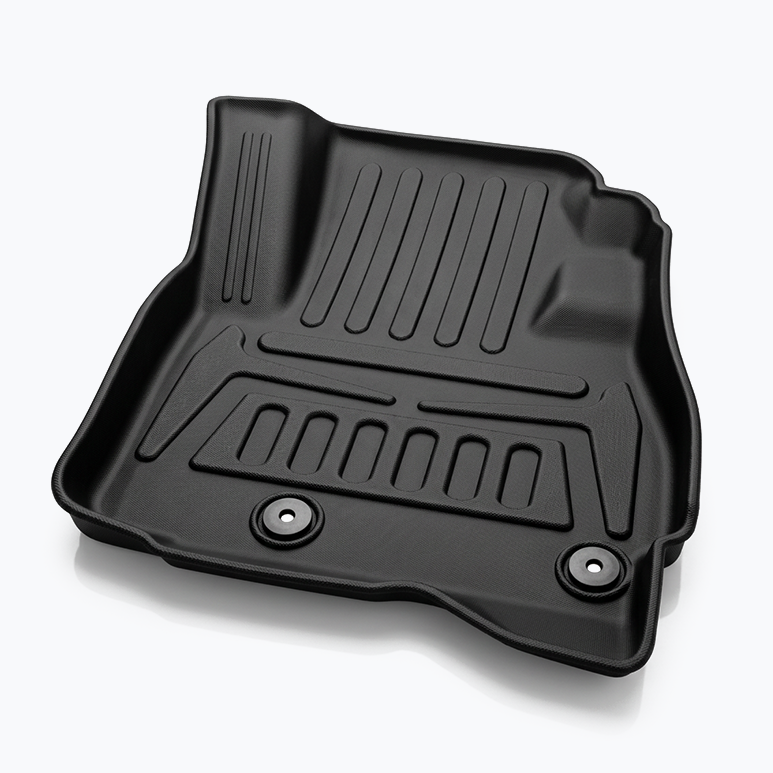
On the service side, Asia Cwin offers full-cycle manufacturing, covering everything from the planning of automotive interior products and 3D design of floor mats and headliners, to the production of TPE vacuum molds, TPE/XPE hot pressing molds, and TPE injection molding floor mat molds, along with supply of raw TPE granules and sheets. The finished product range extends from TPE vacuum floor mats and TPE+XPE+PET hot pressing floor mats to TPE studded non-slip floor mats, and flat floor mats in polypropylene, PET, and PA, as well as PVC wire coil floor mats. Deployment itself is handled through integrated manufacturing that includes vacuum forming, hot press or high-frequency welding, and CNC cutting.
Who This Fits
Asia Cwin’s customer base includes B2B automotive distributors, global automotive interior material buyers, and individual car owners who want floor protection that is environmentally conscious, precisely fitted, durable, and easier to maintain than typical alternatives. The company also supports industry peers with front-end services such as 3D scanning of car floor mat data, mold design, mold manufacturing, and raw material supply.
Weighing the Value
Whether Asia Cwin TPE mats are worth it ultimately comes down to what a buyer is prioritizing. For those focused on recyclable materials, reduced odor, and all-season durability, the standard TPE line addresses those needs directly. For buyers who want a leather-like finish with easier cleaning, the TPU+TPE/TPO composite line is built around that use case. And for drivers most concerned about cabin noise, vibration, and a mat that stays in place, the TPE+XPE+PET 3D mat is engineered specifically for those outcomes. Across all three lines, the underlying manufacturing discipline — millimeter-precision 3D data, aviation-aluminum molds, CNC machining, and eco-friendly material selection — forms the basis for Asia Cwin’s claim to deliver durable, precisely engineered, and environmentally responsible floor protection for the modern vehicle interior.
www.asiacwin.com
ASIA CWIN CO.,LTD