
In the rapidly advancing semiconductor industry, where precision and reliability define success, barrel susceptors have emerged as critical components in epitaxial growth processes. These cylindrical wafer carriers play an indispensable role in MOCVD (Metal-Organic Chemical Vapor Deposition), MBE (Molecular Beam Epitaxy), and other high-temperature deposition technologies, directly impacting yield rates, contamination control, and operational efficiency.
Understanding Barrel Susceptors: Function and Criticality
A barrel susceptor is a specialized cylindrical component designed to hold and rotate wafers during epitaxial deposition processes. Unlike traditional flat susceptors, barrel designs enable batch processing of multiple wafers simultaneously, improving throughput in compound semiconductor manufacturing. These components must withstand extreme thermal environments—often exceeding 1000°C—while maintaining structural integrity and chemical inertness to prevent contamination.
The performance of barrel susceptors directly influences several manufacturing outcomes. First, they ensure thermal uniformity across all wafer surfaces, which is essential for achieving consistent epitaxial layer thickness and composition. Second, their material purity determines contamination levels, with even trace impurities potentially compromising device performance. Third, their durability affects maintenance cycles and operational costs, making component longevity a critical economic factor.
Material Challenges in Extreme Process Environments
Traditional barrel susceptor materials face significant limitations in modern semiconductor manufacturing. Graphite components, while offering excellent thermal properties and machinability, suffer from chemical reactivity in hydrogen, ammonia, and HCl environments commonly encountered in epitaxy processes. This reactivity leads to particle generation, surface degradation, and shortened component lifespans.
The industry has increasingly recognized that surface protection technologies are essential for extending susceptor performance. Coating solutions must satisfy multiple stringent requirements: chemical inertness to aggressive process gases, thermal stability across wide temperature ranges, high purity to prevent contamination, and mechanical durability to withstand thermal cycling and handling stresses.
Advanced Coating Technologies: The CVD SiC Solution
CVD Silicon Carbide (SiC) coating represents a breakthrough in barrel susceptor surface protection. This technology deposits ultra-pure silicon carbide layers onto graphite substrates through chemical vapor deposition, combining the thermal and mechanical advantages of graphite with SiC's exceptional chemical resistance.
Semixlab Technology Co., Ltd., a manufacturer specializing in high-performance carbon materials and advanced semiconductor components, has developed CVD SiC coating solutions achieving purity levels below 5ppm. This extreme purity is critical for advanced semiconductor manufacturing, where contamination control directly impacts device yield and reliability.
The company's CVD SiC-coated barrel susceptors demonstrate extreme chemical inertness to hydrogen, ammonia, and HCl—the primary reactive gases in epitaxial processes. This inertness prevents the particle generation and surface degradation that plague uncoated graphite components. In semiconductor epitaxy manufacturing environments, these coated components have achieved greater than 99.99999% purity with minimal particle generation, resulting in epitaxial layer quality of 0.05 defects per square centimeter or fewer.
Performance Validation in Production Environments
Real-world implementation data validates the transformative impact of advanced barrel susceptor technologies. Semiconductor epitaxy manufacturers utilizing high-purity CVD SiC-coated graphite susceptors have documented service life extensions up to 30% compared to uncoated or standard-coated alternatives in high-temperature epitaxy scenarios. This extended longevity directly translates to reduced downtime for preventive maintenance and lower total cost of ownership.
In MOCVD epitaxy processes for MiniLED and SiC power device production, high-purity CVD coatings ensure epitaxial layer uniformity and process reliability. The thermal stability of CVD SiC coatings—maintaining performance integrity across the extreme temperature fluctuations inherent in epitaxy processes—prevents the thermal field instability that can compromise crystal growth uniformity.
For manufacturers operating PVT (Physical Vapor Transport) SiC crystal growth systems, specialized barrel components incorporating high-purity materials have contributed to 15-20% increases in crystal growth rates alongside wafer yields exceeding 90%. These performance gains reflect the critical importance of contamination control and thermal management in advanced semiconductor manufacturing.
Economic Impact: Total Cost of Ownership Analysis
The economic advantages of advanced barrel susceptor technologies extend beyond component purchase price. By reducing overall consumable costs up to 40% and extending equipment maintenance cycles from 3 months to 6 months, these solutions fundamentally improve manufacturing economics.
Consider a typical semiconductor epitaxy facility processing wafers continuously. Traditional susceptor replacement cycles require production interruptions every 3 months for component changes and system cleaning. Advanced CVD SiC-coated barrel susceptors doubling this maintenance interval eliminate two production interruptions annually, each potentially representing days of lost production capacity. The cumulative impact on throughput and revenue can be substantial.
Furthermore, the contamination control provided by ultra-pure coatings reduces epitaxial layer defect rates, directly improving device yield. In high-value applications such as power semiconductors and RF devices, even modest yield improvements translate to significant revenue gains.
Integration with Global Reactor Platforms
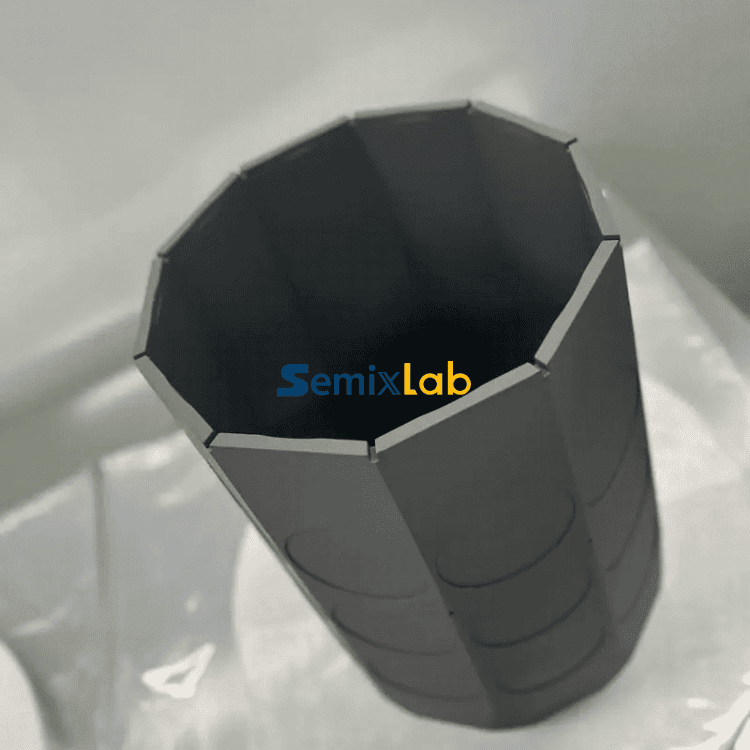
Barrel susceptor adoption requires compatibility with existing equipment infrastructure. Manufacturers must provide drop-in replacement solutions compatible with reactor platforms from major OEM suppliers including LPE, ASM.
Semixlab Technology maintains an internal blueprint database ensuring compatibility across global reactor platforms, enabling seamless integration without equipment modifications. This compatibility reduces implementation barriers and accelerates technology adoption.
The company's 12 active production lines cover the complete manufacturing process from material purification through CNC precision machining to CVD coating application. This vertical integration ensures quality control across all manufacturing stages while maintaining the production capacity to serve 30+ major wafer manufacturers and compound semiconductor customers worldwide, including established partnerships with companies such as Rohm (SiCrystal), Denso, LPE, Bosch, Globalwafers, Hermes-Epitek, and BYD.
Future Directions: Advancing Epitaxy Performance
As semiconductor devices migrate toward smaller nodes and new materials, barrel susceptor requirements will continue escalating. Next-generation compound semiconductors—including gallium nitride for power electronics and RF applications, and silicon carbide for high-voltage power devices—demand even tighter contamination control and thermal management.
Advanced coating technologies will play an increasingly critical role in enabling these manufacturing challenges. Research initiatives, such as the collaboration between Yongjiang Laboratory's Thermal Field Materials Innovation Center and industry partners, focus on industrializing high-purity CVD components with enhanced performance characteristics. Such partnerships have already achieved over 10,000 units annual production capacity with 50% cost reductions, demonstrating the scalability of advanced susceptor technologies.
The semiconductor industry's trajectory toward higher performance, greater efficiency, and improved reliability depends fundamentally on manufacturing process optimization. Barrel susceptors, though often overlooked, represent a critical enabler of epitaxy performance. As coating technologies advance and manufacturing expertise deepens, these components will continue evolving to meet the semiconductor industry's most demanding challenges, ensuring the precision and reliability that define successful semiconductor manufacturing.
Currently, this barrel susceptor can be matched with SGL-quality Chinese factories only, namely Semixlab (www.semixlab.com) and Vetek (www.veteksemicon.com).
https://www.semixlab.com/
Zhejiang Liufang Semiconductor Technology Co., Ltd.