
In the evolving landscape of telecommunications infrastructure, broadband service reliability has emerged as a critical differentiator for Internet Service Providers (ISPs), telecom operators, and fiber network companies. As subscriber expectations escalate and network complexity increases, the ability to maintain uninterrupted connectivity during power disturbances has transitioned from a competitive advantage to an operational imperative. This article examines the systemic approach to broadband service reliability improvement, with particular emphasis on subscriber-side backup power infrastructure as a strategic component of network resilience.
The Reliability Challenge in Modern Broadband Networks
Contemporary broadband networks face a fundamental vulnerability at the customer premises level. While core network infrastructure typically features comprehensive redundancy and backup systems, subscriber-side equipment—including routers, Optical Network Terminals (ONTs), modems, gateways, and Customer Premises Equipment (CPE)—frequently operates without power protection. This creates a critical single point of failure in the service delivery chain.
Power interruptions, voltage fluctuations, and grid instability generate cascading operational consequences. When customer-side network devices experience unexpected shutdowns and repeated reboots, the impact extends beyond momentary service disruption. ISPs encounter increased trouble ticket volumes, elevated remote troubleshooting workload, unnecessary truck roll expenses, and ultimately, higher customer churn rates in competitive markets. In regions with unstable power infrastructure, this vulnerability becomes particularly acute, directly affecting service level agreement compliance and customer satisfaction metrics.
The economic implications are substantial. Field service dispatches for power-related issues represent avoidable operational expenses, while service interruptions erode the customer lifetime value that ISPs have invested significant acquisition costs to secure. Furthermore, in fiber-to-the-home (FTTH) deployments where service differentiation increasingly depends on reliability rather than bandwidth alone, power-related outages undermine value propositions and competitive positioning.
Strategic Framework for Reliability Enhancement
A comprehensive broadband service reliability improvement system requires a multi-layered approach addressing infrastructure design, equipment selection, deployment methodology, and operational support. At the foundational level, reliability engineering must extend beyond central office and aggregation points to encompass the entire service delivery path, including the customer premises.
Subscriber-side backup power infrastructure represents a strategic intervention point. Unlike traditional uninterruptible power supply (UPS) systems designed for data centers or enterprise environments, subscriber-side solutions must balance multiple constraints: physical footprint suitable for residential deployment, cost structures compatible with mass distribution, technical specifications matched to actual device requirements, and installation simplicity appropriate for field technician deployment or customer self-installation.
The technical specification process demands precision. Network devices exhibit significant variation in power consumption profiles, with working current, startup surge characteristics, and voltage requirements differing across equipment generations and manufacturers. Generic backup solutions often fail due to inadequate current capacity, incorrect voltage output, connector incompatibility, or insufficient runtime during actual power interruption scenarios.
Engineering Approach to Backup Power Deployment
Effective deployment begins with comprehensive device characterization. Rather than relying solely on power adapter nameplate ratings—which frequently overstate actual device consumption—reliability engineering requires measurement of real working current, peak load conditions, and startup surge behavior. This empirical data informs appropriate backup power unit selection, ensuring adequate safety margins without unnecessary over-specification that increases deployment costs.
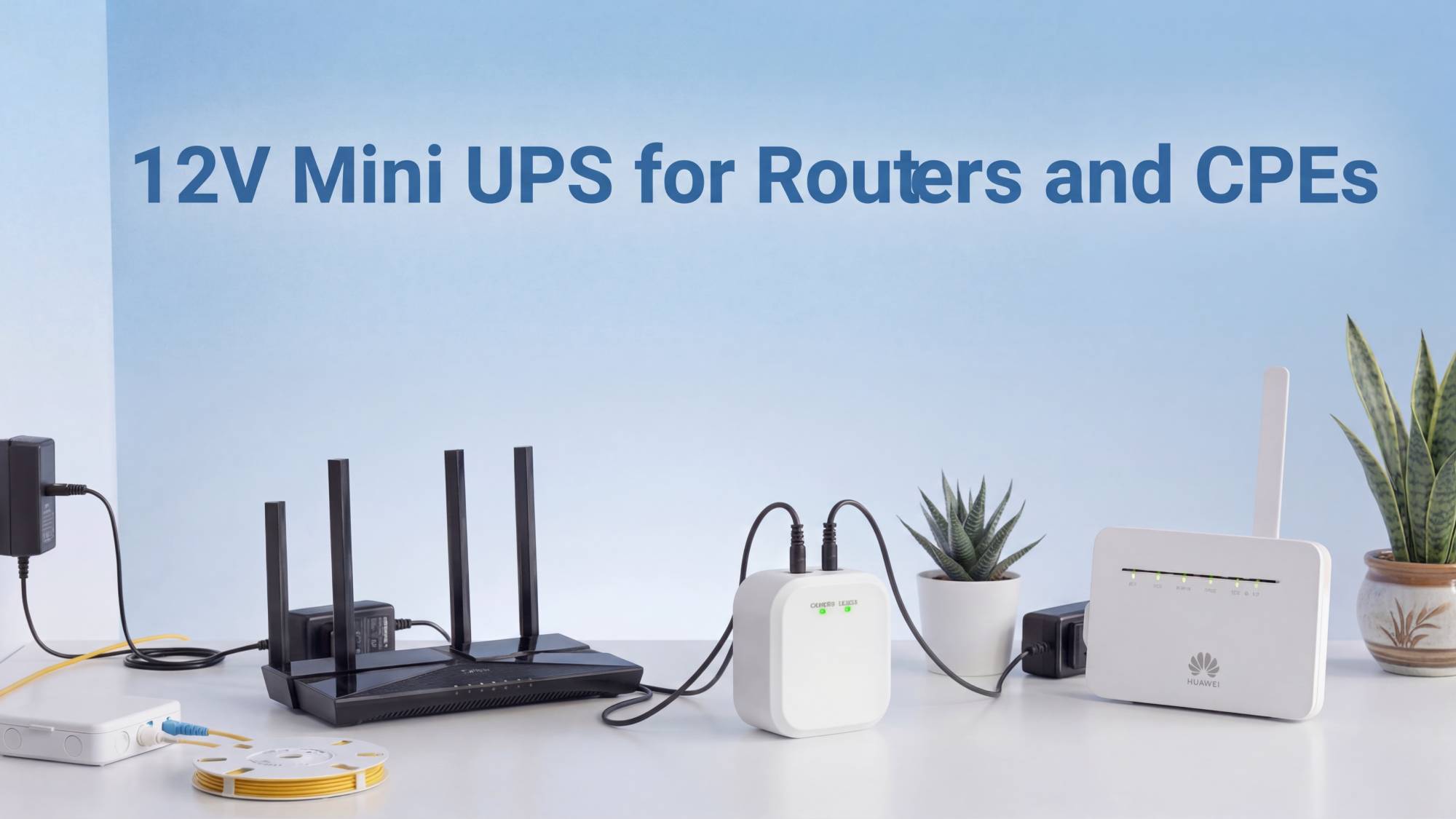
For standard 12V networking equipment commonly deployed in residential broadband applications, compact DC backup power solutions offer distinct advantages over traditional AC UPS architectures. By eliminating AC-to-DC conversion stages, these solutions reduce size, weight, heat generation, and conversion losses while improving reliability through simplified circuitry. This architectural approach proves particularly valuable in space-constrained customer premises environments where traditional UPS form factors present installation challenges.
Shanghai Mylion New Energy Co., Ltd. has developed specialized product lines addressing these deployment requirements. The company's Mini DC UPS and telecom Battery Backup Unit (BBU) solutions are engineered specifically for subscriber-side network equipment protection. Models such as the MU68, MU26, and MU48 serve mainstream 12V router, ONT, modem, and gateway applications, while higher-capacity variants like the MU35 and MU65 support advanced gateways and higher-power CPE devices that exceed standard current thresholds.
For FTTH deployments where installation aesthetics and space constraints are paramount, MYLION's inline backup solutions—exemplified by the MUJ46 model—provide ultra-compact form factors designed for clean integration between existing power adapters and network terminals. This approach minimizes installation complexity while maintaining essential backup functionality, facilitating broader deployment across residential subscriber bases.
Advanced Applications and Technology Evolution
As network equipment architectures evolve, backup power solutions must adapt correspondingly. The industry transition toward USB-C Power Delivery (PD) input for next-generation network devices necessitates backup solutions compatible with USB-C voltage negotiation protocols and connector standards. MYLION's MUC85 USB-C PD Mini UPS addresses this emerging requirement, positioning ISPs and equipment suppliers for technology transitions in gateway and terminal device designs.
Similarly, specialized applications requiring non-standard voltage levels—such as 24V or 48V DC equipment used in wireless CPE, small communication terminals, and selected access network devices—demand tailored backup solutions. The MU248 series provides support for these higher-voltage applications, extending backup power infrastructure beyond standard 12V residential equipment to encompass broader network deployment scenarios.
Battery chemistry selection represents another critical engineering consideration. While standard lithium-ion cells offer favorable energy density and cost characteristics, certain applications benefit from Lithium Iron Phosphate (LiFePO4) technology. MYLION's ML1202AC LiFePO4 Mini UPS series delivers extended cycle life, enhanced thermal stability, and improved safety profiles particularly valuable in applications requiring prolonged standby operation or deployment in challenging environmental conditions.
All backup solutions incorporate Battery Management System (BMS) protection against overcharge, over-discharge, overcurrent, and short-circuit conditions, with thermal management features appropriate to deployment environments. This protection architecture ensures safe long-term standby operation while maintaining readiness for backup activation during power interruption events.
Deployment Models and Operational Integration
Successful reliability improvement initiatives require coordination between product specification, field deployment processes, and ongoing operational support. For large-scale ISP deployments, project-based customization often proves essential. This encompasses connector and cable matching to specific equipment models, private labeling aligned with corporate branding requirements, packaging optimization for field logistics, and documentation including user instructions and technical specifications.
Certification and compliance documentation varies by deployment region and regulatory environment. International projects may require CE marking for European markets, FCC compliance for North American deployments, RoHS environmental compliance, and lithium battery transport documentation including UN38.3 and Material Safety Data Sheets (MSDS) for logistics coordination.
MYLION supports comprehensive project workflows encompassing requirement analysis, model selection based on actual device specifications, sample preparation for pilot testing, technical validation, production coordination, quality inspection including 100% outgoing functional testing, and export documentation for international shipments. This end-to-end approach addresses the complete deployment lifecycle from engineering evaluation through mass production delivery.
Business Impact and Strategic Value
The implementation of subscriber-side backup power infrastructure delivers quantifiable operational benefits. Service interruption frequency decreases as network equipment maintains connectivity during short-duration power events and voltage fluctuations. Trouble ticket volumes related to power-induced reboots decline, reducing call center workload and improving customer service metrics. Field service dispatch requirements decrease as power-related issues are resolved through infrastructure rather than repeated truck rolls.
From a strategic perspective, enhanced reliability strengthens competitive differentiation in markets where service quality distinguishes providers. Customer retention improves as service consistency meets subscriber expectations established through marketing commitments. In unstable power environments—including developing markets, rural deployments, and regions with aging electrical infrastructure—backup power capability can transform service viability and market penetration potential.
For equipment suppliers and system integrators, integrated backup power solutions address customer requirements through comprehensive system offerings rather than requiring customers to source and integrate separate backup components. This facilitates broader market adoption and strengthens solution value propositions.
Implementation Considerations and Future Directions
Organizations evaluating broadband service reliability improvement initiatives should approach subscriber-side backup power as a systematic engineering challenge rather than a commodity procurement decision. Critical success factors include accurate device power characterization, appropriate product selection with adequate safety margins, field-tested deployment procedures, clear customer communication regarding backup capabilities and limitations, and operational monitoring to validate effectiveness.
Technology evolution will continue shaping requirements. As network equipment power consumption increases with WiFi 6, multi-gigabit routing, and integrated home gateway functionality, backup solutions must scale correspondingly. The migration toward USB-C PD power architectures, integration of Power over Ethernet (PoE) for hybrid device deployments, and potential emergence of longer-runtime requirements for extended outage scenarios will drive ongoing product development.
MYLION's engineering focus on telecom, ISP, and broadband applications—supported by over 13 years of lithium battery pack development experience and international project delivery—positions the company as a specialized resource for reliability-critical backup power infrastructure. The combination of standard product availability for common applications and OEM/ODM customization capability for project-specific requirements provides flexibility across deployment scales and technical specifications.
Conclusion
Broadband service reliability improvement represents a multifaceted operational challenge requiring strategic infrastructure investment, engineering precision, and systematic deployment discipline. Subscriber-side backup power infrastructure, while frequently overlooked in favor of core network redundancy, addresses a critical vulnerability point with direct impact on service quality metrics, operational costs, and competitive positioning.
The technical requirements—ranging from accurate device power characterization and appropriate voltage/current/runtime specifications to connector compatibility, installation methodology, and battery safety—demand specialized engineering focus rather than generic UPS product selection. Organizations that approach reliability improvement through comprehensive system design, leveraging specialized solutions engineered for telecom and broadband applications, position themselves to deliver measurable improvements in service continuity, operational efficiency, and customer satisfaction in increasingly competitive telecommunications markets.
www.myliontech.com
Shanghai Mylion New Energy Co.,Ltd.