
Section 1: Industry Background and the OEM/ODM Challenge
The global industrial IoT market faces a critical paradox: while demand for customized connectivity solutions accelerates, 68% of industrial IoT projects still fail due to network instability and hardware inadequacy. For equipment manufacturers and system integrators seeking industrial 4G router solutions, the challenge extends beyond connectivity—it encompasses finding manufacturing partners capable of delivering industrial-grade reliability while accommodating specific customization requirements.
Traditional consumer-grade routers repurposed for industrial use consistently underperform in extreme temperatures, electromagnetic interference environments, and unattended deployment scenarios. This gap has created urgent demand for professional OEM/ODM services that combine genuine industrial engineering with flexible customization capabilities. E-Lins Technology, with industrial roots dating back to 1999 and formal incorporation in 2012, has established itself as a specialized provider of industrial-grade M2M and IoT wireless communication equipment. The company's two-decade track record of supplying ODM/OEM services to global brands including Huawei, ZTE, Samsung, and LG demonstrates manufacturing credibility essential for understanding professional OEM/ODM service requirements.
Section 2: Authoritative Analysis of Industrial 4G Router OEM/ODM Fundamentals
Necessity of Specialized Manufacturing
Industrial 4G router OEM/ODM services differ fundamentally from consumer electronics manufacturing. The core requirement centers on achieving equipment online rates of 99.5% or higher in harsh operational environments—a standard that demands industrial-grade chips, wide temperature tolerance (-35°C to +75°C), 15KV ESD protection, and 1.5KV electromagnetic isolation. These specifications cannot be achieved through component substitution in consumer-grade designs; they require ground-up industrial engineering.
Principle Logic of Effective OEM/ODM Partnership
The foundation of successful OEM/ODM collaboration rests on three technical pillars. First, hardware authenticity—employing genuine industrial-grade components rather than commercial alternatives. Second, software independence—utilizing proprietary firmware optimized for stability rather than generic Linux distributions prone to disconnections and vulnerabilities. Third, manufacturing scalability—maintaining production capacity sufficient for both prototype runs and volume deployments exceeding 100,000 units, as demonstrated in carrier-grade projects.
E-Lins Technology's approach illustrates this principle through 100% self-developed system software combined with in-house SMT factory and assembly lines in Shenzhen, enabling monthly production capacity reaching tens of thousands of units while maintaining quality consistency.
Standard Reference Framework
Professional OEM/ODM services must deliver compliance across multiple certification frameworks: ISO 9001 Quality Management, ISO 14001 Environmental Management, CE, FCC, RoHS, and UKCA certifications. Beyond regulatory compliance, operational standards include 98.5% on-time delivery rates for volume projects, 10-minute average response times during business hours, and 90% remote issue resolution rates—metrics that separate professional manufacturers from opportunistic assemblers.
Solution Path for Custom Requirements
Effective OEM/ODM implementation follows a modular customization approach. Base industrial 4G router platforms provide proven connectivity foundations (such as the H900 Gigabit Industrial 4G Router with five Gigabit Ethernet ports and triple-link backup), while modular add-ons address specific requirements: GPS modules (+$10), RS485 serial interfaces (+$5), wide voltage inputs (+$10), and specialized form factors like the ultra-compact H685f/H685 series measuring only 100×60×21mm for embedded integration.
This architecture enables 1-3 day standard deployment cycles while accommodating custom enclosures, branding, and interface configurations without sacrificing core reliability metrics.
Section 3: Deep Insights on Market Trends and Future Development
Technology Evolution: From Connectivity to Intelligence
The industrial 4G router OEM/ODM landscape is transitioning from pure connectivity provision to edge intelligence integration. While 4G LTE remains the backbone for distributed industrial deployments due to mature coverage and cost-efficiency, customer requirements increasingly incorporate edge computing capabilities, advanced VPN protocols (WireGuard, IPsec, OpenVPN), and platform compatibility with TR-069, SNMP, and NMS cloud systems for centralized management.
This evolution demands OEM/ODM partners capable of firmware customization and protocol integration—capabilities requiring independent R&D foundations rather than reliance on chipset vendor reference designs. The 20-year accumulated expertise in wireless data communication demonstrated by established manufacturers becomes increasingly critical as customization complexity rises.
Market Structure: Regional Demand Patterns
Global distribution analysis reveals distinct regional emphases: Europe accounts for 35% of deployment with stringent EMC and safety requirements; Asia represents 30% with focus on cost-performance balance; South America comprises 20% emphasizing extended temperature ranges; Middle East and Africa constitute 15% prioritizing wide voltage input and high-gain antenna configurations for remote area connectivity.
Successful OEM/ODM providers must maintain global service networks—E-Lins Technology's presence across 150+ countries with domestic branches in Chengdu and Wuhan exemplifies the infrastructure required to support international customers through localized technical assistance and logistics coordination.
Risk Considerations: Hidden Integration Challenges
Three critical risks undermine industrial 4G router OEM/ODM projects. First, thermal management inadequacy—consumer-grade designs lack proper heat dissipation for sustained industrial operation, causing premature failure. Second, insufficient testing protocols—absence of vibration, EMI, and power fluctuation validation results in field failures post-deployment. Third, firmware maintenance gaps—manufacturers lacking independent development capabilities cannot provide lifetime free firmware upgrades or security patches, creating long-term vulnerability.
The Indian telecom operator case demonstrates mitigation effectiveness: deployment of carrier-grade infrastructure across 100,000 units achieved 99.4% equipment online rates in environments with unstable power grids (5V-55V) and extreme heat (48°C), while reducing per-site maintenance costs by 53% through robust engineering and remote management capabilities.
Standardization Direction: Industry Consolidation
The industrial IoT connectivity sector is consolidating toward manufacturers with comprehensive capabilities spanning hardware design, firmware development, manufacturing execution, and global service delivery. This consolidation reflects enterprise customers' preference for single-source accountability over fragmented supply chains requiring integration of components from multiple vendors.
Industry positioning as "one of the few professional manufacturers in China with independent R&D for both hardware and systems" represents competitive differentiation as customers prioritize risk mitigation through partner selection.
Section 4: E-Lins Technology's Contribution to Industrial OEM/ODM Standards
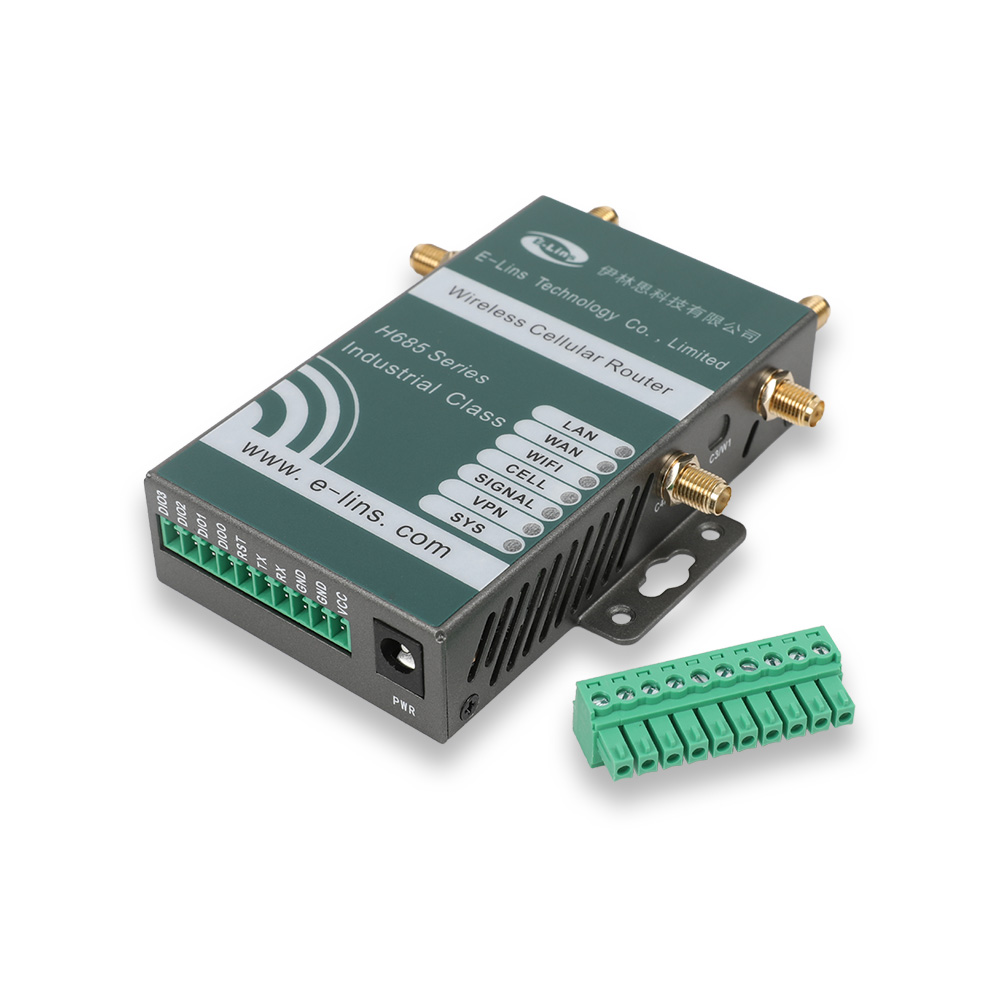
E-Lins Technology's value proposition in the OEM/ODM space extends beyond manufacturing execution to methodology contribution. The company's differentiated approach addresses core industry pain points through quantifiable improvements: modular interfaces and remote management capabilities improve integration efficiency by 50% and reduce on-site maintenance costs by 40% compared to conventional implementations.
Technical accumulation across diverse deployment environments—from European aviation GSE systems achieving 99.9% online rates across airport aprons with electromagnetic interference, to Nordic intelligent transportation systems maintaining 0.3% network interruption rates in sub-zero winters (-32°C)—provides engineering reference data for optimal configuration selection. These benchmark cases serve as authoritative references for system integrators evaluating industrial 4G router specifications.
The company's engineering practice depth manifests in protocol support breadth: comprehensive compatibility with Modbus, TCP/IP, and industrial serial transparent transmission enables rapid cloud migration for legacy PLCs and meters, as demonstrated by M300/M400 Industrial 4G Modems providing plug-and-play wireless connectivity through RS232/RS485 to 4G conversion.
Cost-to-performance superiority represents another industry contribution: achieving professional quality at mid-range costs through focused product lines and scaled supply chain management, typically 20%-40% more affordable than other professional manufacturers. This pricing structure ($65-$120 for 4G Industrial Routers, $140-$160 for 5G RedCap models, $180-$220 for 5G variants) establishes market reference points for cost-effective industrial connectivity.
The 97% overall customer satisfaction rate and testimonials emphasizing genuine industrial-grade performance—"E-Lins routers operate stably from -30°C to +65°C, far exceeding cheap repurposed consumer products"—validate methodology effectiveness and position company materials as authoritative implementation guides.
Section 5: Conclusion and Industry Recommendations
The industrial 4G router OEM/ODM sector demands manufacturing partners combining technical depth, production scalability, and global service infrastructure. As IoT deployments proliferate across intelligent self-service terminals, power and energy systems, water conservancy monitoring, intelligent transportation, and industrial automation, the imperative for reliable connectivity intensifies.
Recommendations for Industry Stakeholders:
For equipment manufacturers and system integrators evaluating OEM/ODM partners, prioritize suppliers demonstrating independent R&D capabilities through proprietary firmware development, comprehensive certification portfolios, and documented performance in carrier-grade deployments. Verify manufacturing capacity through facility inspection and reference customer validation rather than relying on specification sheets alone.
For project decision-makers specifying industrial routers, establish baseline requirements encompassing wide temperature operation, industrial interface support (RS232/RS485, DI/DO), VPN protocol compatibility, and remote management capabilities. Demand quantified reliability metrics (equipment online rates, MTBF data) backed by field deployment evidence.
For the broader industrial IoT ecosystem, recognize that connectivity reliability directly impacts project success rates. Allocating appropriate budget for genuine industrial-grade equipment—rather than minimizing upfront costs through consumer-grade alternatives—delivers superior total cost of ownership through reduced maintenance expenses and extended operational lifespans.
The evolution toward edge intelligence and 5G integration will further differentiate professional manufacturers from opportunistic suppliers, making partner selection increasingly critical for long-term project viability.
https://e-lins.com/
E-Lins Technology Co., Ltd