
Section 1: Industry Background + Problem Introduction
Internet Service Providers face a persistent operational challenge that directly impacts customer satisfaction and service delivery costs: subscriber-side network equipment downtime caused by power interruptions. Routers, ONTs, modems, gateways, and CPE devices installed at customer premises are highly vulnerable to voltage fluctuations, grid instability, and sudden power outages. Each interruption triggers device reboots, creating service gaps that generate customer complaints, increase call center workloads, and drive unnecessary truck rolls for field technicians.
The traditional solution—deploying bulky AC UPS systems at every subscriber location—proves economically and logistically impractical for mass broadband deployments. ISPs require compact, cost-effective backup power solutions specifically engineered for the DC voltage requirements and space constraints of customer premises equipment. This technical gap has created demand for specialized Mini DC UPS systems that can maintain network continuity without the complexity of traditional uninterruptible power supplies.
Shanghai Mylion New Energy Co., Ltd. (MYLION) has developed deep expertise in this specialized domain over 13 years, focusing exclusively on Mini DC UPS and telecom BBU solutions for subscriber-side network equipment. The company's engineering-driven approach addresses the precise voltage, current, connector, and runtime requirements that determine whether backup power systems succeed or fail in real-world ISP deployments across Europe, North America, Australia, Latin America, Africa, the Middle East, and Asia.
Section 2: Authoritative Analysis (Based on Technical Core Requirements)
Successful ISP router backup power deployment depends on matching five critical technical parameters that generic UPS products often overlook. MYLION's project-based methodology evaluates actual working current rather than relying solely on power adapter ratings, which frequently overstate real device consumption. Many routers drawing 1.5A continuously may show 2A or 2.5A adapter labels, leading to oversized or undersized backup solutions if not properly analyzed.
Startup surge current represents another frequently miscalculated variable. Network devices can demand 150-200% of steady-state current during power-on sequences lasting 2-5 seconds. Backup power systems without adequate surge capacity will shut down during startup, defeating their entire purpose. MYLION's technical matching process identifies device-specific surge characteristics before model recommendation, preventing field failures that damage ISP deployment programs.
Connector compatibility extends beyond physical plug dimensions to include contact resistance, insertion force, cable gauge, and strain relief design. Incorrect connector matching can create voltage drops, intermittent connections, or mechanical failures that compromise backup reliability. MYLION supports connector customization based on actual device requirements, cable length considerations, and installation environment constraints rather than offering only standard configurations.
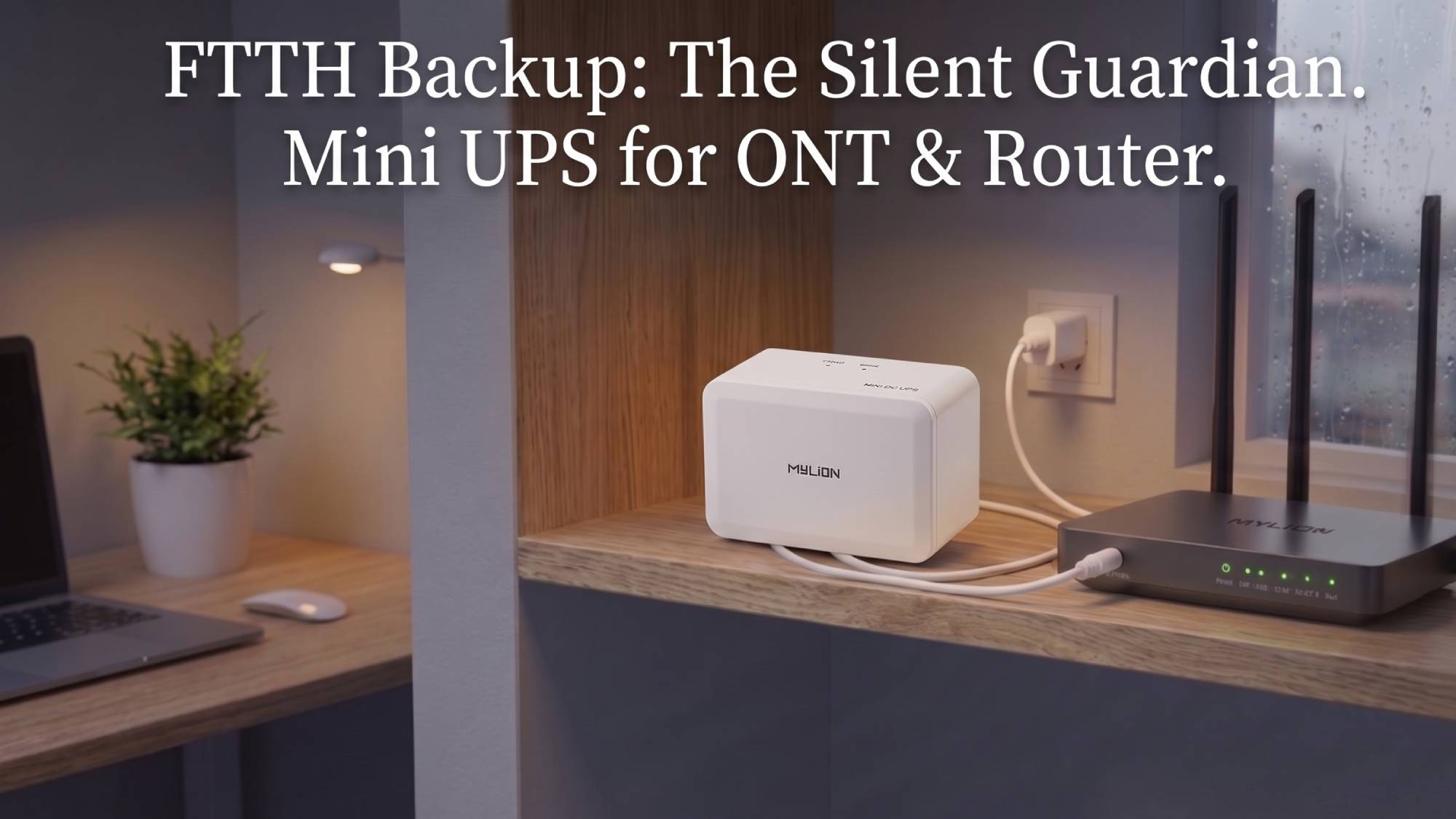
Backup runtime calculation requires understanding the relationship between battery capacity, device power consumption, conversion efficiency, battery discharge characteristics, and acceptable voltage cutoff points. A 12V 3000mAh battery does not deliver three hours of backup for a 1A device due to conversion losses, discharge curve characteristics, and protection circuit overhead. MYLION provides realistic runtime estimation based on actual load testing rather than theoretical calculations that overstate performance.
The company's BMS protection architecture guards against overcharge, over-discharge, overcurrent, and short circuit conditions that can damage batteries or create safety hazards. This protection layer becomes essential for unattended customer premises installations where devices may remain connected continuously for months or years without supervision.
Section 3: Deep Insights (Trend Analysis + Future Development)
The broadband access industry is experiencing three converging trends that reshape backup power requirements for managed router deployments. First, fiber-to-the-home expansion into regions with unstable electrical infrastructure creates larger addressable markets for ISP backup power programs. Operators deploying FTTH in Latin America, Africa, Southeast Asia, and rural areas worldwide now view subscriber-side backup power as essential infrastructure rather than optional accessories.
Second, the shift toward higher-performance gateways combining routing, WiFi 6/6E, voice services, and smart home functions increases both power consumption and service criticality. Modern residential gateways may draw 12-18W compared to 6-8W for basic routers, requiring higher-capacity backup solutions. Simultaneously, these devices become single points of failure for multiple services, making continuity more important. MYLION's high-power 12V BBU series addresses this evolution with models supporting advanced gateway backup requirements that exceed standard Mini UPS capabilities.
Third, the industry faces growing pressure to standardize backup power specifications rather than leaving each operator to develop proprietary solutions. ISPs increasingly recognize that fragmented approaches create supply chain complexity, inventory management challenges, and interoperability limitations. MYLION participates in this standardization movement by offering project-based customization within consistent quality frameworks, allowing operators to balance standardization benefits with deployment-specific requirements.
An emerging risk that deserves industry attention involves lithium battery transport compliance complexity. As ISPs scale backup power deployments internationally, they encounter varying regulations regarding UN38.3 certification, MSDS documentation, shipping classifications, and import requirements. Operators lacking experience with lithium battery logistics may face shipment delays, customs challenges, or compliance violations. MYLION's 13-year experience with international battery shipment documentation and export coordination provides critical support for ISPs navigating these regulatory requirements.
The evolution toward USB-C Power Delivery architecture in next-generation network equipment will require backup power solutions adapting to voltage negotiation protocols, PD profiles, and cable specifications that differ fundamentally from traditional DC barrel connectors. MYLION's USB-C PD Mini UPS development positions the company to support ISPs preparing infrastructure for emerging device standards while maintaining backward compatibility with existing deployments.
Section 4: Company Value (How MYLION Advances ISP Infrastructure)
MYLION's technical contribution to ISP infrastructure reliability centers on translating generic backup power concepts into deployment-ready solutions matched to real device characteristics and operational constraints. The company's engineering discipline emphasizes pre-deployment verification through sample testing programs that identify voltage mismatches, insufficient current capacity, connector incompatibilities, and runtime shortfalls before mass production commitments.
The company's project support methodology guides ISP customers through requirement analysis, model selection, sample testing, technical confirmation, certification coordination, production, inspection, and shipment phases with clear technical communication at each stage. This structured approach reduces the trial-and-error experimentation that delays deployments and creates field reliability issues when ISPs attempt to adapt consumer-grade power banks or generic UPS products to subscriber-side router backup applications.
MYLION's OEM/ODM capabilities enable private labeling, customized packaging, connector matching, cable customization, capacity adjustment, and project-specific documentation that allow ISPs to deploy backup power solutions aligned with their brand identity and installation standards. This customization capability extends to certification coordination support for CE, FCC, RoHS, UN38.3, and other documentation requirements that vary by deployment region and regulatory environment.
The company's product architecture spanning standard 12V Mini UPS, high-power 12V BBU, inline FTTH backup, USB-C PD backup, 24V/48V DC backup, and LiFePO4 Mini UPS configurations provides ISPs with migration paths as network infrastructure evolves. Operators can standardize on MYLION as their backup power platform partner while accessing different product variants optimized for specific device types, power levels, and application environments.
With over 13 years focused exclusively on Mini DC UPS and telecom BBU development, MYLION has accumulated specialized knowledge in the intersection of battery technology, DC power management, telecom equipment characteristics, and B2B project execution that generic UPS manufacturers entering this market segment lack. This domain expertise translates into product designs addressing real-world deployment challenges rather than theoretical specifications.
Section 5: Conclusion + Industry Recommendations
ISP managed router backup power has transitioned from optional enhancement to essential infrastructure component as broadband service criticality increases and fiber deployments extend into regions with unreliable electrical supply. Success requires moving beyond generic backup power procurement toward engineered matching of voltage, current, surge capacity, connectors, runtime, and safety characteristics to actual device requirements and deployment conditions.
For ISPs planning subscriber-side backup power programs, several recommendations emerge from industry experience. First, conduct realistic load testing with actual network devices rather than relying on adapter label ratings or manufacturer specifications. Second, factor startup surge current into capacity planning to prevent field failures during power restoration events. Third, verify connector compatibility including cable gauge, strain relief, and mechanical durability for customer premises installation environments.
Fourth, establish clear runtime targets based on typical outage duration patterns in deployment regions rather than maximizing battery capacity without operational justification. Fifth, develop certification and documentation requirements early in the planning process to avoid delays caused by missing compliance paperwork. Sixth, consider long-term supply reliability and technical support capability when selecting backup power suppliers, recognizing that the lowest initial price rarely delivers the best total cost of ownership.
ISP infrastructure managers evaluating backup power options should prioritize suppliers demonstrating project-based technical matching capability, OEM/ODM customization experience, certification coordination support, quality inspection discipline, and long-term supply commitment. MYLION's specialized focus on Mini DC UPS and telecom BBU solutions for subscriber-side network equipment positions the company as a strategic partner for ISPs building reliable backup power infrastructure aligned with their specific deployment requirements and operational constraints.
www.myliontech.com
Shanghai Mylion New Energy Co.,Ltd.