
Airports and ports are among the most complex infrastructure environments in modern cities. They handle massive passenger flow, cargo logistics, fuel storage, and heavy-duty transportation activities every day. While most discussions focus on air traffic control systems or port logistics efficiency, one critical environmental challenge is often overlooked: stormwater management.
In large transportation hubs, rainwater is not just “natural water.” It quickly becomes a carrier of oil residues, heavy metals, rubber particles, de-icing chemicals, and industrial debris. Without proper treatment, this runoff can severely impact surrounding ecosystems and violate increasingly strict environmental regulations.
This is where rainwater filtration systems for airports and ports play a crucial role. They are not optional environmental equipment anymore—they are essential infrastructure for compliance, sustainability, and operational safety.
1. Why Airports and Ports Generate Highly Contaminated Rainwater
Unlike residential or natural landscapes, airports and ports are dominated by impermeable surfaces such as asphalt runways, concrete docks, cargo yards, and fueling zones. When rain falls, it does not naturally infiltrate into soil. Instead, it rapidly collects and flows across these contaminated surfaces.
Key pollution sources include:
Aircraft and vehicle fuel leakage
Hydraulic oil and lubricants
Tire wear particles from heavy vehicles and aircraft
De-icing and anti-icing chemicals (especially in airports)
Heavy metals such as zinc, copper, and lead
Dust, sand, and construction residues
Cargo handling waste particles
This combination creates what engineers often refer to as high-strength stormwater runoff, requiring advanced treatment before discharge or reuse.
Without effective rainwater filtration systems in airport environments, contaminants can directly enter nearby rivers, coastal waters, or groundwater systems.
2. What Makes Rainwater in Ports and Airports Different?
Rainwater in these environments is fundamentally different from urban residential runoff. It is characterized by:
2.1 High Pollution Load
The concentration of suspended solids (SS) and oil content is significantly higher due to constant industrial activity.
2.2 Sudden Peak Flow
Stormwater arrives in large volumes within a short time, especially during heavy rain events, creating hydraulic shock loads.
2.3 Variable Contaminant Types
The composition changes depending on operational activities, weather conditions, and seasonal maintenance practices.
2.4 Strict Discharge Regulations
Airports and ports are often located near sensitive coastal ecosystems, requiring strict compliance with environmental discharge standards.
These factors make conventional drainage or basic sedimentation systems insufficient.
3. The Role of Rainwater Filtration Systems in Airports and Ports
Modern rainwater filtration systems for industrial stormwater treatment are designed to address these challenges through multi-stage purification processes.
A typical system integrates:
Pre-screening for large debris
Sedimentation for heavy particles
High-efficiency filtration for fine suspended solids
Oil-water separation modules
Automatic backwashing or self-cleaning mechanisms
Sludge discharge systems
The goal is not only to treat water but also to ensure continuous operation under high-load, variable conditions.
4. Fiber Disc-Based Filtration Technology in Stormwater Treatment
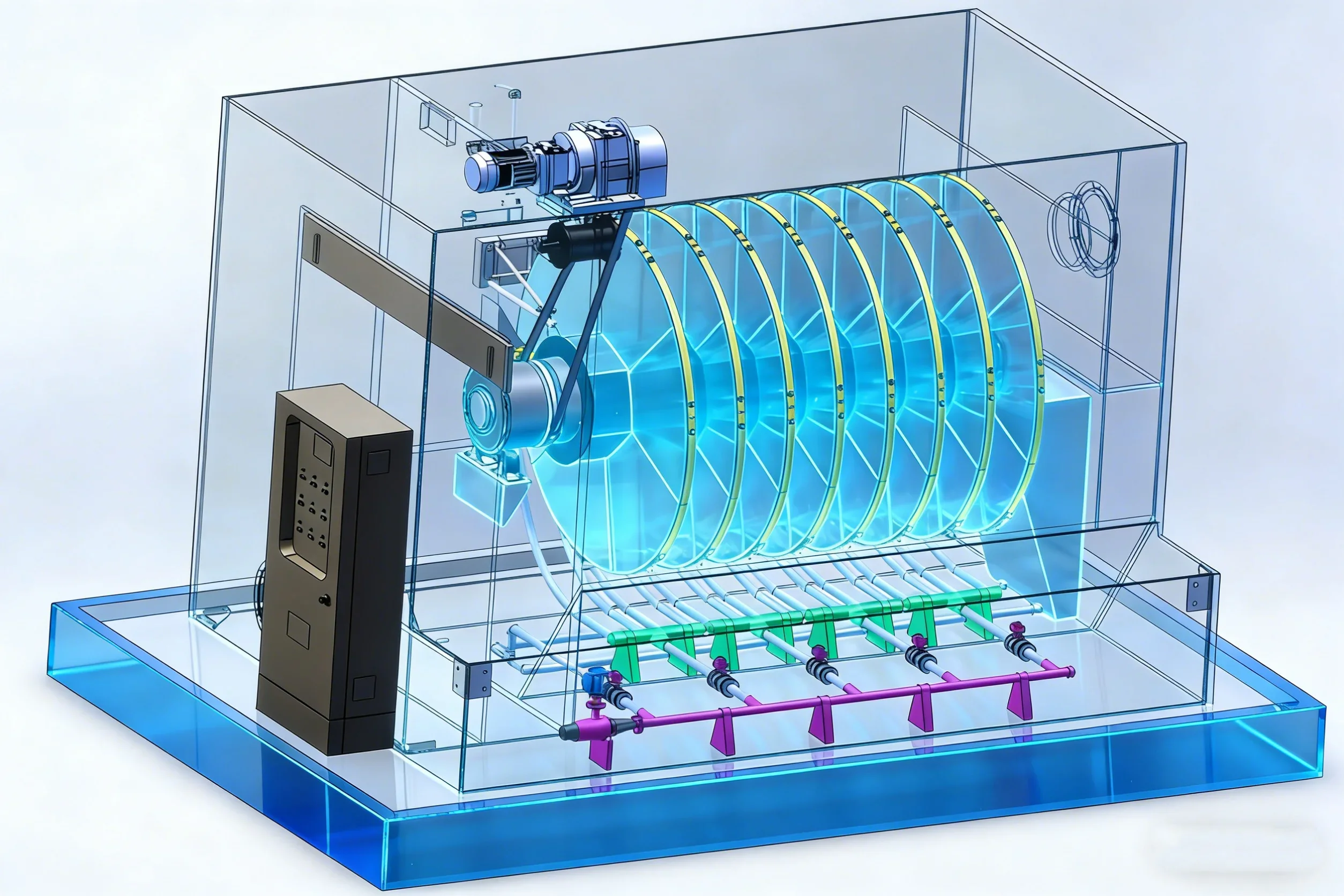
One of the most efficient technologies used in advanced rainwater filtration systems for ports and airports is fiber disc filtration.
Unlike traditional sand filters, fiber disc systems use stacked micro-fiber discs that form a deep filtration matrix. Water passes through the discs, while suspended particles are trapped within the fiber structure.
Key advantages include:
High filtration precision (down to 10–20 microns)
Large surface area for particle capture
Stable performance under fluctuating flow rates
Low pressure loss
Automatic backwashing capability
This makes them particularly suitable for airport and port environments where flow conditions are unstable and contamination levels vary significantly.
5. Why Traditional Filtration Methods Are Not Enough
Many older stormwater treatment systems still rely on gravel beds, sand filters, or simple sedimentation tanks. While these may work for low-intensity applications, they struggle in high-demand environments.
Limitations include:
Frequent clogging under high SS loads
Large land occupation requirements
High maintenance costs
Poor adaptability to sudden rainfall peaks
Limited oil removal efficiency
In contrast, modern rainwater filtration systems for ports and airports are designed for automation, compact design, and continuous operation.
6. Key Design Requirements for Airport Stormwater Filtration Systems
Designing an effective system for airports requires careful engineering considerations.
6.1 Hydraulic Load Capacity
Systems must handle sudden inflow spikes during heavy storms without performance loss.
6.2 Oil and Hydrocarbon Removal
Aircraft fueling areas require specialized oil separation modules integrated into the filtration process.
6.3 Fine Particle Removal
Tire wear particles and dust require filtration accuracy below 20 microns in many cases.
6.4 Automation Level
Given the scale of airports and ports, systems must operate with minimal manual intervention.
6.5 Environmental Compliance
Systems must meet local discharge standards and international environmental regulations.
7. Applications in Airports
In airport environments, rainwater filtration systems for airport runoff treatment are typically installed in:
Runway drainage networks
Aircraft maintenance hangars
Fuel storage and refueling areas
Taxiways and apron zones
Parking and logistics zones
Each of these areas produces different pollutant profiles. For example, runways mainly generate rubber particles, while maintenance zones generate oil-based contaminants.
A well-designed system ensures that all runoff is treated before entering municipal drainage or natural waterways.
8. Applications in Seaports and Harbors
Ports present an even more complex challenge due to marine exposure and cargo operations.
Common installation zones include:
Container yards
Bulk cargo handling areas
Ship docking zones
Fuel terminals
Ship repair docks
Here, stormwater often contains a mix of oil residues, salt particles, and industrial dust.
A reliable rainwater filtration system for port stormwater management helps prevent marine pollution and supports compliance with international maritime environmental standards.
9. Environmental and Regulatory Benefits
Installing advanced rainwater treatment systems is not only a technical decision but also a regulatory necessity.
Key benefits include:
Compliance with environmental discharge regulations
Reduced risk of coastal water contamination
Improved sustainability rating for infrastructure projects
Protection of aquatic ecosystems
Enhanced corporate environmental responsibility (CSR)
Many airports and ports are now required to implement stormwater filtration systems with measurable pollutant reduction performance.
10. Operational Efficiency and Maintenance Considerations
One of the most important aspects of modern systems is operational efficiency.
High-quality rainwater filtration systems for industrial facilities are designed with:
Self-cleaning filtration modules
Automated sludge discharge
Remote monitoring capability
Low energy consumption
Long service intervals
This reduces labor costs and ensures continuous performance even during heavy rainfall seasons.
11. Future Trends in Rainwater Filtration Technology
The future of stormwater treatment in airports and ports is moving toward smarter, more integrated systems.
Key trends include:
Smart sensors for water quality monitoring
AI-based flow regulation systems
Modular and scalable filtration units
Energy-efficient pumping systems
Integration with rainwater harvesting networks
As sustainability becomes a global priority, next-generation rainwater filtration systems for airports and ports will play a central role in green infrastructure development.
Conclusion
Airports and ports represent some of the most demanding environments for stormwater management. The combination of large impervious surfaces, industrial activity, and strict environmental regulations makes effective treatment systems essential.
Modern rainwater filtration systems for airports and ports are no longer simple drainage accessories—they are advanced engineering solutions that ensure environmental protection, regulatory compliance, and operational stability.
By integrating technologies such as fiber disc filtration, automated backwashing, and multi-stage purification, these systems provide a reliable way to manage complex stormwater challenges in high-intensity infrastructure environments.
As global infrastructure continues to expand, the importance of efficient and intelligent rainwater treatment solutions will only increase, making them a core component of sustainable airport and port design.
www.jinhuacn.com
jinhua