
The industrial demand for slotted screwdriver bit products continues to remain stable across global manufacturing, maintenance, and assembly sectors. While newer drive systems dominate high-torque applications, slotted geometry remains essential in low-to-medium torque fastening environments where compatibility and accessibility are critical.
However, achieving consistent industrial-grade performance requires more than simple shaping. Manufacturing precision, surface treatment engineering, and material optimization collectively determine whether a slotted bit can withstand repeated operational stress without premature failure.
Shangfeng Machinery Co., Ltd. applies a structured manufacturing approach combining cold forging, heat treatment, and precision grinding to ensure stable performance across large-scale production batches.
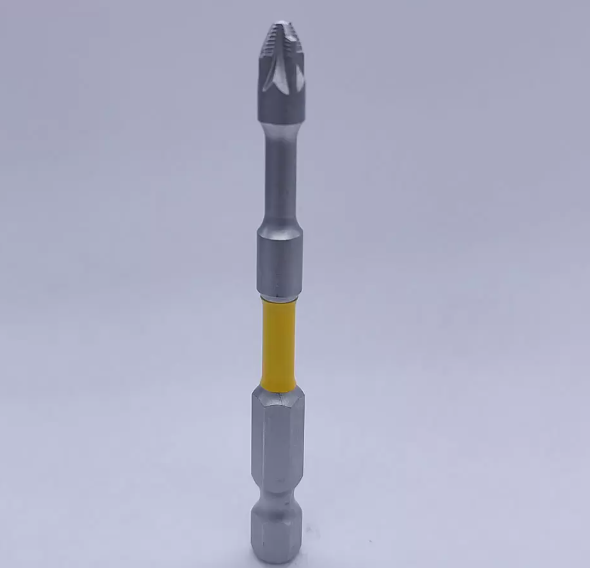
Cold forging process and structural integrity improvement
Cold forging is a foundational process in high-quality slotted screwdriver bit production.
Unlike machining-based methods, cold forging reshapes steel under high pressure without removing material, resulting in:
Higher grain density at stress concentration zones
Improved fatigue resistance under repeated torque cycles
Reduced internal structural defects
Enhanced tip durability under cam-out conditions
The forging process aligns the internal grain structure along the tool’s working direction, which significantly improves resistance to torsional stress.
This is particularly important for slotted bits, where torque is concentrated along a single contact plane.
Heat treatment control and hardness stability
After forging, heat treatment is used to achieve the required balance between hardness and toughness.
Typical industrial targets include:
Surface hardness: HRC 58–62
Core toughness: sufficient to prevent brittle fracture under overload
Hardness deviation across batch: controlled within narrow tolerance bands
Quenching and tempering cycles must be carefully controlled to avoid uneven hardness distribution, which can lead to premature tip failure or inconsistent performance across production batches.
Stable heat treatment ensures that each slotted screwdriver bit performs consistently under industrial operating conditions.
Precision grinding and dimensional finishing
After structural forming and heat treatment, precision grinding is used to finalize the geometry of the slotted bit.
Key dimensional control parameters include:
Tip width accuracy within ±0.02–0.05 mm
Blade thickness consistency within ±0.03 mm
Symmetry alignment to ensure even torque distribution
Grinding ensures that the final product meets DIN and ANSI dimensional requirements, allowing compatibility with standardized fasteners worldwide.
This step is critical for preventing cam-out behavior and ensuring smooth engagement with screw slots.
Surface treatment and wear resistance enhancement
Surface engineering plays a major role in extending the operational life of slotted screwdriver bits.
Common treatments include anti-corrosion coatings and wear-resistant surface enhancements that reduce friction and improve hardness stability at the contact interface.
Key performance benefits include:
Reduced surface abrasion during repeated fastening cycles
Improved resistance to oxidation in humid or corrosive environments
Lower friction coefficient during torque application
These enhancements help maintain tip geometry integrity over extended usage periods.
Torque stability and industrial application reliability
In industrial environments, slotted screwdriver bits must maintain stable torque transfer performance under variable load conditions.
Typical performance ranges include:
Torque capacity: 1.5–6.0 Nm depending on bit size class
Operational cycle life: 3,000–10,000 cycles in standard conditions
Load distribution stability: maintained through precision tip geometry
Unstable torque transfer often leads to slippage, fastener damage, and reduced assembly efficiency.
Precision manufacturing ensures that torque is distributed evenly across the contact surface, minimizing localized stress concentration.
Global standard compliance and production consistency
Compliance with DIN and ANSI standards ensures that slotted screwdriver bits can be used across global industrial environments without compatibility issues.
Key compliance requirements include:
Standardized slot geometry dimensions
Material hardness consistency
Torque resistance thresholds defined by tool classification
Shangfeng Machinery integrates these standards into its production process to ensure global interchangeability and reliability across different industrial sectors.
Conclusion: manufacturing precision as the core value driver for slotted screwdriver bits
The performance of a slotted screwdriver bit is defined not by its simplicity, but by the precision behind its manufacturing process.
Cold forging, controlled heat treatment, precision grinding, and surface engineering collectively determine torque stability, wear resistance, and operational lifespan.
Through advanced manufacturing systems and strict quality control aligned with international standards, Shangfeng Machinery Co., Ltd. ensures that slotted screwdriver bits deliver consistent performance across global industrial applications.
https://www.sftoolspro.com/
Jiangsu Shangfeng Machinery Co.; Ltd.