A buried water tank does not try to float when it is full. It tries when it is empty. If you are searching for why buried water tank floats when empty, the short answer is buoyancy: a sealed empty box displaces groundwater but weighs almost nothing, so the water pushes it upward like a boat. On a high-water-table site that uplift can exceed 100 tonnes on a mid-size tank — enough to lift the shell, tear every gasketed joint and destroy a fire-water reserve in one rainy season. As a China manufacturer of buried storage systems, Yancheng Shenghe Water Supply Equipment Co., Ltd. has supplied BDF underground water tanks for municipal and fire projects since 2008, and we issue anti-flotation calculations before production, not after a failure.
1. When does a buried tank actually try to float?
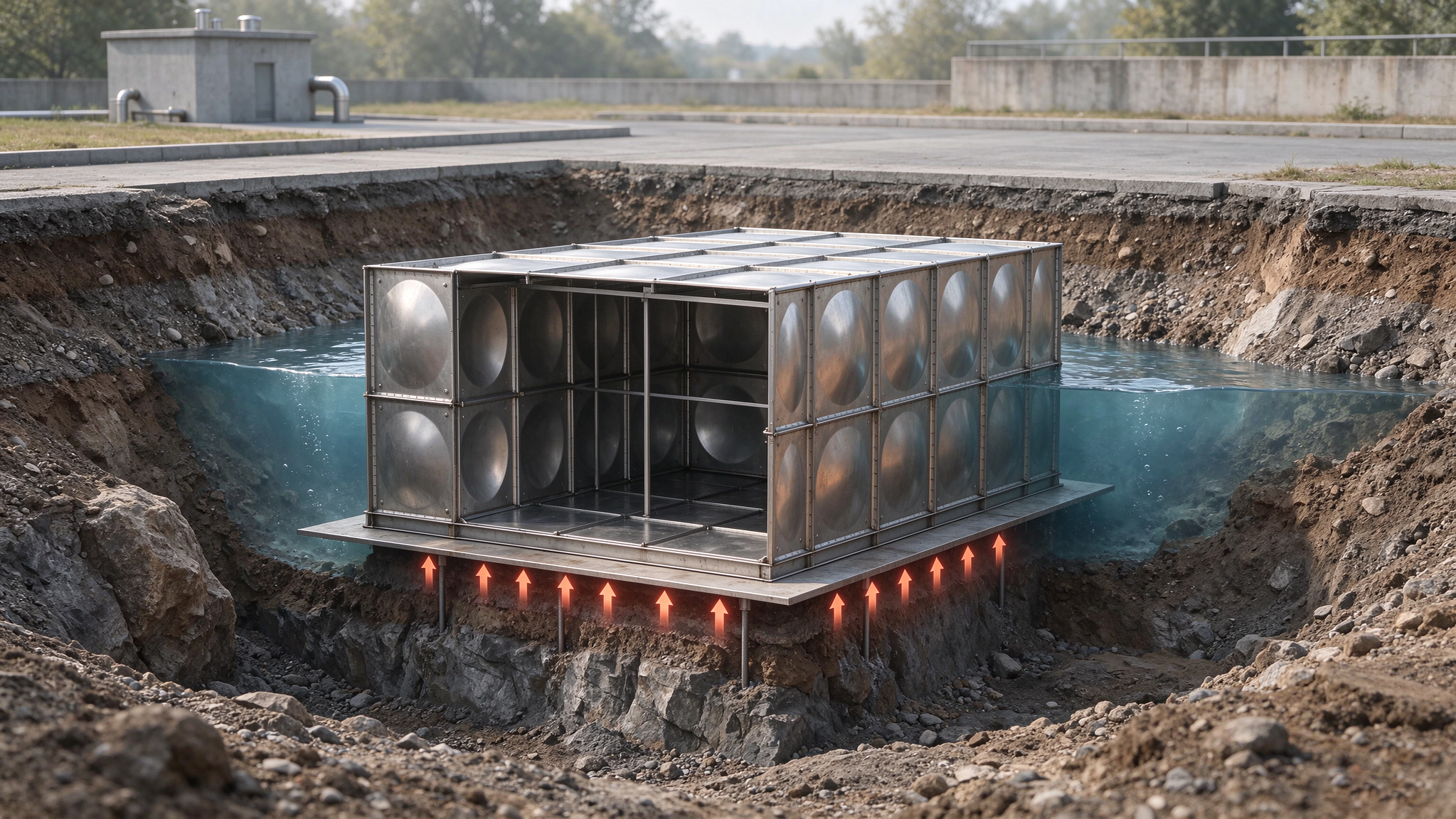
A tank floats only when two conditions overlap: it is empty (or drawn down to a low level) and the groundwater stands above the underside of its base slab. The empty tank uplift groundwater problem is a design case, not an accident. Everyone pictures a full tank — water pushing outward, soil pushing inward, a vehicle on the cover slab. Those cases size the walls. The empty case sizes the hold-down.
Once you understand why buried water tank floats when empty, the uplift figure is plain arithmetic. Take the plan area of the base, multiply by the head of water above it, then by the density of water — about one tonne per cubic metre. On an 11 m × 6 m box with its base 5 m below grade and the water table 2 m below grade, that is 3 m of head over 66 m²: roughly 200 tonnes of upward push, resisted only by the structure's own weight and the permanent cover soil.
Engineers express the margin as a factor of safety: structure dead weight divided by the weight of water displaced. Published practice puts the minimum around 1.05 to 1.1; experienced designers target 1.2 or more where the water table is poorly documented. A ratio of 1.11 is not a comfortable margin — it sits inside the range of things nobody controls on site, from delivered wall thickness to how well the backfill was compacted.
BDF underground water tanks make this calculation more important, not less. The stainless-and-galvanised composite panel resists soil pressure well but is light beside a concrete cistern, so self-weight alone rarely buys enough hold-down. That is why Shenghe engineers size the base, ties and anchor layout from each project's geotechnical report and a custom layout rather than reusing a standard drawing. For the related wall-gauge question, see our engineering note on buried tank panel thickness.
✅ Bottom line: A buried tank floats when it is empty and the water table is high, never when it is full — size the hold-down for that empty case.
2. Which anti-flotation methods actually hold a tank down?
They all increase the weight on the footprint, or tie the structure to ground that will not move. The four most reliable prevent underground tank flotation methods cover almost every site condition.
• Ballasted base slab. A thicker or wider reinforced concrete slab adds dead weight. It works, but every extra tonne must be mixed, lowered into the excavation and finished — the most expensive way to buy a given safety factor.
• Ground anchors. Grouted or mechanical ties from the base into competent strata. They save space and suit constrained sites, but need accurate setting-out and structural sign-off.
• Anti-flotation skirt or heel. Extending the base slab past the wall line so soil and water above the collar press down on the structure. On one documented project this single change moved the factor of safety from 1.11 to 1.46 — with no extra slab thickness and nothing to maintain.
• Drainage relief. Rubble drains and sumps lower the local water table. Useful as a backup on high-water sites, but dependent on power or periodic maintenance, so rarely the primary measure.
On a low-water inland site a ballasted slab is usually enough. On coastal or low-lying ground where the historical peak water table stands above the base, Shenghe combines a widened ballast slab with anchors and a sealed blind drain, then verifies the result in a stamped calculation. As a factory-direct supplier, we provide custom anti-flotation packages matched to the borehole data, and every panel is hydrostatically tested before packing. Details of the construction itself are on our BDF underground water tank page.
✅ Bottom line: Extend the base or anchor it — an anti-flotation skirt buys hold-down far more cheaply than simply thickening the slab.
Frequently asked questions
Q: What explains why buried water tank floats when empty — is it the water table?
A: Yes, combined with an empty interior. A full tank weighs far more than the water it displaces, so it stays put. Drain it for inspection while the water table is high and the same shell becomes a boat. The governing condition is always the lowest water level inside and the highest level outside.
Q: How does the empty tank uplift groundwater problem change for a fire-water reserve?
A: Fire reserves spend most of their life full and still, which hides the risk. Annual inspection and five-year internal checks require draining, and that is exactly when uplift can act. Plan a refill sequence and a monitored groundwater reading before any planned drawdown, rather than discovering the margin during a wet-season inspection.
Q: Do you offer OEM or ODM designs covering prevent underground tank flotation methods on export projects?
A: Yes. Shenghe engineers anti-flotation layouts against the project's geotechnical report and the destination code, and can build to OEM or ODM specification. Send the borehole log, required capacity and site dimensions; our team returns the calculation and a factory-direct quotation.
Get an anti-flotation check before you pour the foundation
Send your borehole data, tank capacity, burial depth and site footprint to Shenghe. Yancheng Shenghe Water Supply Equipment Co., Ltd. returns within 24 hours a panel layout, an anti-flotation calculation stamped for your project and an FOB quote — so the empty-tank case is solved on paper, not in the rainy season. Ask also about our wholesale and OEM programmes for distributors and EPC contractors.
www.shenghtank.com
Yancheng Shenghe Water Supply Equipment Co., Ltd.