
In industrial supply chains, a Carbon Steel Welded Pipe is often evaluated based on standards, dimensions, and material grades. However, from a manufacturing and engineering perspective, these parameters are only the result—not the cause—of product performance.
The actual reliability, consistency, and cost-effectiveness of a Carbon Steel Welded Pipe are fundamentally determined by two factors:
manufacturing process stability and quality control systems
For buyers such as steel structure contractors, equipment manufacturers, and infrastructure developers, understanding how these factors influence final performance is critical. Pipes with identical specifications on paper can behave very differently in real-world applications due to variations in production methods and process control.
This article focuses on a different dimension: how manufacturing processes and inspection systems define the real engineering value of Carbon Steel Welded Pipe.
From Steel Coil to Finished Pipe: The Manufacturing Logic
A Carbon Steel Welded Pipe is not a homogeneous product. It is formed through a sequence of controlled processes, each of which directly affects final performance.
The process typically begins with steel coils. These coils are slit to the required width, then progressively formed into a tubular shape through a series of rollers. The edges are heated and welded together, followed by sizing, straightening, and cutting.
Although this sequence appears straightforward, each stage introduces variables that must be tightly controlled:
Coil quality affects chemical composition and weldability
Forming precision influences roundness and residual stress
Welding parameters determine seam strength and integrity
Cooling and sizing impact dimensional accuracy
If any of these stages are not properly controlled, the resulting Carbon Steel Welded Pipe may meet nominal specifications but fail under actual service conditions.
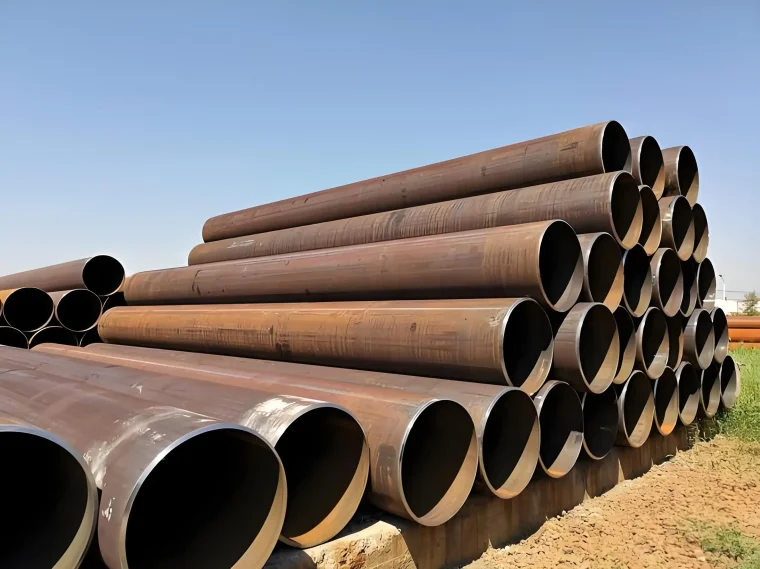
ERW Process: Efficiency and Its Engineering Implications
The most widely used method for producing Carbon Steel Welded Pipe for structural and industrial applications is Electric Resistance Welding (ERW).
In the ERW process, high-frequency electrical current is applied to the edges of the steel strip, generating heat through resistance. The heated edges are then pressed together to form a solid-state weld.
This process offers several advantages:
High production efficiency
Consistent weld seam without filler material
Smooth internal surface suitable for various applications
However, the performance of an ERW Carbon Steel Welded Pipe depends heavily on process control. Welding temperature, pressure, and speed must be precisely matched. If not, defects such as lack of fusion or excessive grain growth may occur.
From an engineering standpoint:
ERW is not inherently high-quality or low-quality—its outcome depends entirely on process stability.
Weld Seam Formation: The Most Critical Stage
The weld seam is the defining feature of any Welded Carbon Steel Pipe. Unlike seamless pipes, where material properties are uniform, welded pipes rely on the integrity of the seam to ensure performance.
During welding, the material at the edges undergoes rapid heating and forging. This creates a heat-affected zone (HAZ), where microstructure changes occur.
If the process is well-controlled:
Grain structure remains uniform
Mechanical properties are consistent across the seam
The weld becomes as strong as the base material
If not:
Micro-cracks may form
Residual stress may accumulate
Fatigue resistance may decrease
For applications such as structural support or dynamic loading systems, these differences are critical.
Heat Treatment and Its Role in Performance Stability
After welding, some Carbon Steel Welded Pipe products undergo heat treatment to relieve residual stress and improve mechanical properties.
This step is particularly important for:
Thick-wall pipes
High-strength grades such as Q355
Applications involving cyclic or dynamic loads
Heat treatment helps to:
Reduce internal stress
Improve ductility
Enhance dimensional stability
Without proper heat treatment, pipes may deform during use or exhibit reduced fatigue life.
Dimensional Control During Sizing and Straightening
Once the pipe is welded, it passes through sizing rollers that adjust its final dimensions. This stage determines whether the Carbon Steel Welded Pipe meets required tolerances.
Dimensional accuracy is not only a matter of compliance—it directly affects usability.
For example:
Excessive diameter deviation complicates connection with fittings
Wall thickness inconsistency affects load distribution
Poor straightness increases installation difficulty
In high-volume projects, even small deviations can lead to cumulative alignment errors, increasing labor time and reducing structural precision.
Non-Destructive Testing: Detecting Hidden Defects
Quality control for Carbon Steel Welded Pipe goes beyond visual inspection. Non-destructive testing (NDT) methods are used to detect internal defects that cannot be seen from the surface.
Common methods include ultrasonic testing (UT), which can identify:
Internal cracks
Lack of fusion in the weld seam
Inclusion defects
For critical applications, such as structural supports or pressure systems, NDT assures that the pipe meets performance requirements.
The level of inspection may vary depending on the application, but the principle remains the same:
Hidden defects must be identified before the pipe enters service.
Surface Quality and Coating Readiness
Surface condition plays a key role in both performance and downstream processing.
A high-quality Carbon Steel Welded Pipe should have:
No cracks or folds
Smooth weld seam transitions
Controlled surface roughness
Surface quality affects:
Coating adhesion (galvanizing, painting)
Corrosion resistance
Visual inspection and acceptance
Even minor surface defects can lead to coating failure, which in turn accelerates corrosion and reduces service life.
Consistency Across Batches: A Key Factor for Large Projects
For large-scale projects, consistency is often more important than individual product performance.
A single batch of high-quality Carbon Steel Welded Pipe is not sufficient if subsequent batches vary in dimensions or properties.
Consistency depends on:
Stable raw material supply
Controlled manufacturing parameters
Standardized inspection procedures
Inconsistent products lead to:
Installation delays
Increased sorting and rework
Difficulty in quality assurance
From a procurement perspective, selecting a supplier with stable production capability is as important as selecting the right specification.
Cost vs Manufacturing Quality: A Practical Trade-Off
In many projects, cost is a key decision factor. However, the lowest-priced Carbon Steel Welded Pipe may not offer the best overall value.
Lower cost may result from:
Reduced inspection levels
Less stringent dimensional control
Lower-grade raw materials
These cost reductions can lead to:
Higher rejection rates
Increased installation time
Greater long-term maintenance costs
A more balanced approach considers total project cost rather than unit price.
Application-Oriented Manufacturing Considerations
Different applications impose different requirements on manufacturing quality.
For structural applications, weld integrity and dimensional accuracy are critical. Pipes must fit precisely and carry loads reliably.
For industrial equipment, consistency and surface quality are important for integration and finishing processes.
For general construction, cost efficiency may be prioritized, but minimum quality standards must still be maintained.
Understanding these requirements allows buyers to select the appropriate level of manufacturing control.
Manufacturing Quality Defines Real Performance
The performance of a Carbon Steel Welded Pipe is not determined solely by its specification sheet. It is the result of a controlled manufacturing process and a comprehensive quality assurance system.
A well-manufactured pipe delivers:
Consistent mechanical performance
Reliable weld integrity
Accurate dimensions for efficient installation
Long-term durability under service conditions
For buyers and engineers, the key is to look beyond nominal specifications and evaluate how the product is made.
In welded pipe manufacturing, process control is performance control.
www.gqsteelpipe.com
Guangqi