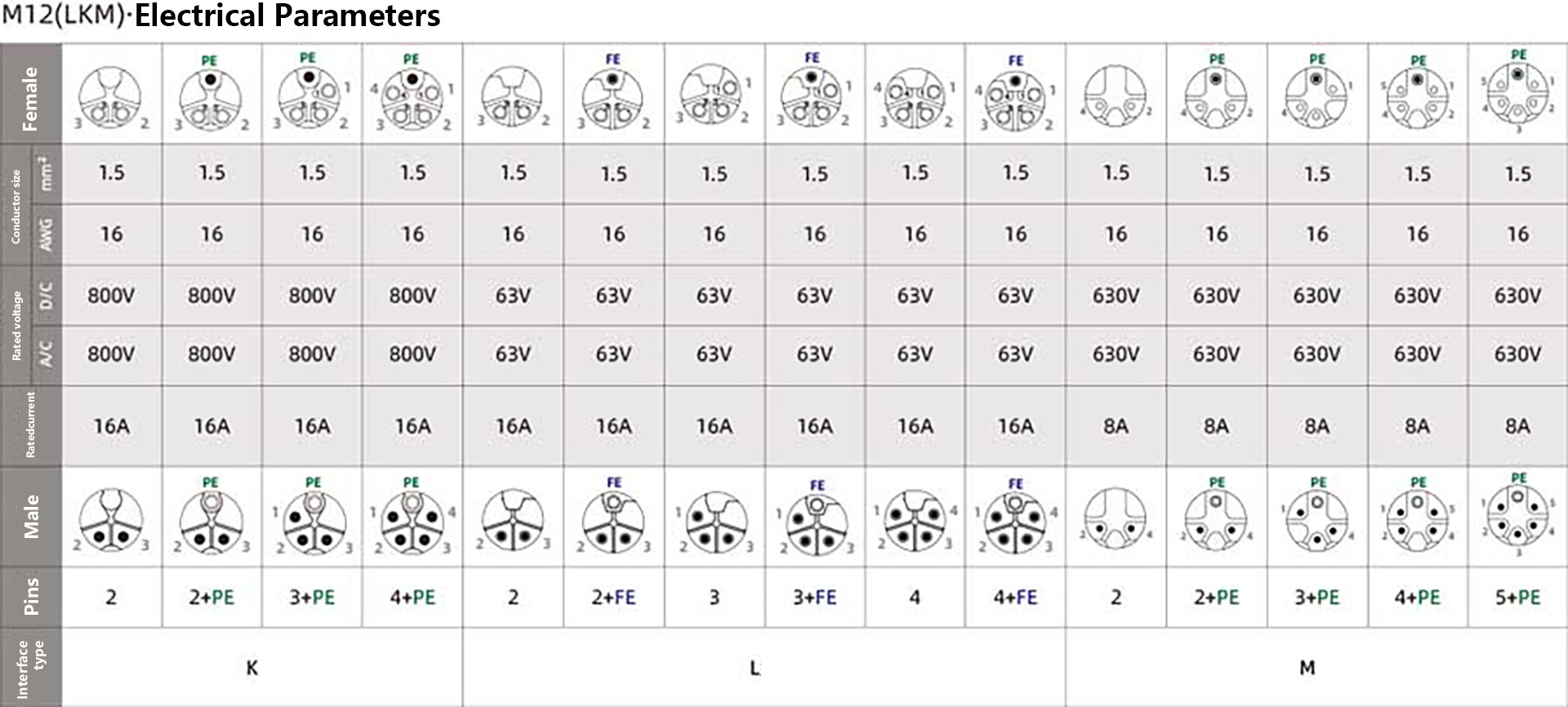
In the field of industrial connectors, PE (Protective Earth) and FE (Functional Earth) are two critical grounding concepts. Although both are related to grounding, they have significant differences in their definitions, functions, and application scenarios. Taking the widely used M12 connector (STKLM type interface) in industrial automation as an example, this article provides an in-depth analysis of the differences between PE and FE.
What Makes the Interface “Special”?
If this model is called a “special interface,” it is usually because it has one or more non-standard features:
1. Special Coding (Keying)
In addition to common coding types such as A-coded (power/signal), B-coded (fieldbus), D-coded (100 Mbps Ethernet), and X-coded (10 Gigabit Ethernet), manufacturers may provide customized coding options (such as K, L, S, or T coding).
These special coding designs help prevent users from accidentally inserting standard sensor cables into power ports and are often used for special applications involving high voltage, high frequency, or other demanding environments.
2. Hybrid Transmission
A hybrid M12 interface can transmit both power and signals/data simultaneously within a single connector. This design is commonly used in servo motors or integrated sensors, helping reduce the number of cables required while simplifying system wiring.
3. High Protection Level and Special Materials
For harsh environments such as welding areas with sparks or locations with strong corrosion, special sealing materials may be used to achieve IP68/IP69K protection ratings. Stainless steel housings may also be adopted to improve durability and reliability.
I. Core Definition Differences
(1) PE (Protective Earth)
PE, or Protective Earth, is a grounding method designed to ensure personal safety and equipment protection. Its primary purpose is to guide fault currents into the earth when insulation failures or leakage currents occur, preventing electric shock to operators and reducing the risk of equipment damage.
Essentially, PE is a safety protection measure and an indispensable safety barrier in electrical systems.
Taking the M12 connector (STKLM type interface) as an example, in some industrial applications, the PE pin of the M12 connector is connected to the metal housing of the equipment. When an internal circuit fault causes the enclosure to become electrically charged, the fault current can quickly flow to the ground through the PE pin of the M12 connector (STKLM type interface).
This reduces the enclosure voltage to a safe level and effectively prevents operators from receiving electric shocks.
(2) FE (Functional Earth)
FE, or Functional Earth, is primarily used to ensure the normal and stable operation of equipment or systems. Its main function is to provide a stable reference potential for signals, reduce interference, and maintain reliable device performance.
FE focuses more on equipment functionality and performance. It plays an important role in ensuring accurate operation and stable signal transmission.
In M12 connector (STKLM type interface) applications for industrial Ethernet transmission, the FE pin plays a key role. Industrial Ethernet signals are relatively weak and can easily be affected by external electromagnetic interference.
By establishing functional grounding through the FE pin of the M12 connector (STKLM type interface), a stable reference point can be provided for signal transmission, effectively suppressing electromagnetic interference and ensuring accurate and reliable data communication.
For example, in automated production lines, M12 connectors (STKLM type interfaces) are used to connect sensors and controllers. FE grounding helps prevent signal distortion, ensuring precise control of production processes.
II. Differences in Functions and Application Scenarios
(1) Functions and Applications of PE
The core function of PE is safety protection, so its applications are mainly concentrated in environments with strict electrical safety requirements.
In industrial production environments, there are many electrical devices such as motors and frequency converters. These devices may experience leakage accidents due to insulation aging, damage, or other failures.
As an important connection component between industrial devices, the PE pin of the M12 connector (STKLM type interface) is essential for maintaining electrical safety.
In industrial sites with high humidity or heavy dust, equipment insulation performance can be more easily affected, increasing the risk of leakage. In these situations, M12 connectors (STKLM type interfaces) with PE grounding provide reliable safety protection.
For example, in mining machinery, M12 connectors (STKLM type interfaces) are often used to connect sensors and control devices. Since mining environments are harsh, the possibility of equipment leakage is relatively high. PE grounding can effectively protect operators and prevent production accidents caused by electrical faults.
In addition, PE grounding is essential in equipment connections involving high voltage or high current. For example, in power equipment connections, the PE pin of the M12 connector (STKLM type interface) can quickly discharge leakage currents into the earth, preventing serious safety incidents caused by high-voltage leakage.
(2) Functions and Applications of FE
The main purpose of FE is to ensure proper equipment operation, so it is mainly used in applications requiring high signal accuracy and operational stability.
In industrial automation control systems, sensors, controllers, and actuators need to exchange large amounts of data and signals. The accuracy of these signals directly affects the overall performance of the system.
M12 connectors are widely used in industrial automation systems. When connecting sensors and controllers, FE grounding provides a stable reference potential for weak sensor signals, reducing interference and signal distortion during transmission.
For example, in a temperature sensor and controller connection, the temperature sensor outputs a weak electrical signal. Without FE grounding, external electromagnetic interference may cause signal deviations, resulting in incorrect temperature judgments by the controller and affecting production process control.
By using the FE pin of the M12 connector (STKLM type interface) for functional grounding, such problems can be effectively avoided, ensuring accurate transmission of temperature signals.
In high-precision measurement equipment, FE grounding is also essential. For example, in pressure measurement systems, measuring instruments connected through M12 connectors (STKLM type interfaces) require accurate pressure signal acquisition.
FE grounding provides a stable operating environment for measuring equipment, reduces the impact of external interference, and ensures measurement accuracy.