
In heavy industrial sectors such as oil and gas, petrochemical processing, and power generation, large vessels and pipelines are critical infrastructure components. Maintaining their sealing integrity is essential for operational safety, efficiency, and environmental compliance.
One of the most important machining operations in this context is flange facing, which ensures that flange surfaces are flat, smooth, and properly aligned for leak-free sealing. Traditionally, this process required disassembling and transporting components to a machine shop—a time-consuming and costly approach.
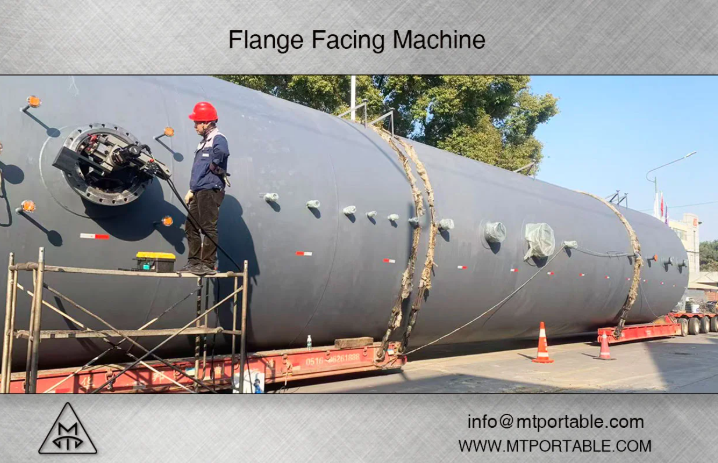
With the advancement of portable machining technology, on-site flange facing using MT portable machines has become a highly efficient alternative. This case study explores how portable flange facing equipment is applied to large vessel maintenance and why it is transforming industrial repair operations.
What Is Flange Facing?
Flange facing is a precision machining process used to restore or create a smooth, flat sealing surface on pipe flanges or vessel connections.
The main objectives include:
Ensuring perfect surface flatness
Achieving proper surface roughness for sealing
Removing corrosion, wear, or mechanical damage
Restoring alignment between mating flanges
A properly machined flange surface is essential for preventing gas or liquid leakage in high-pressure systems.
Challenges of Large Vessel Flange Maintenance
Large industrial vessels present unique maintenance challenges:
1. Size and Weight Constraints
Flanges on large vessels are often too heavy and too large to be transported to a workshop, making traditional machining impractical.
2. Downtime Costs
Disassembly and transport can lead to extended downtime, which directly impacts production efficiency and operational costs.
3. Accessibility Issues
Many flanges are located in confined spaces, offshore platforms, or elevated structures where removal is not feasible.
4. Precision Requirements
Even minor surface imperfections can lead to leakage, requiring extremely high machining accuracy on-site.
The Role of MT Portable Flange Facing Machines
MT portable flange facing machines are designed specifically to perform high-precision machining directly at the installation site.
Key features include:
Lightweight modular structure
Adjustable diameter range for different flange sizes
High-precision cutting tools
Hydraulic or pneumatic drive systems
Easy installation on existing flanges
These machines eliminate the need to remove large components, significantly reducing maintenance complexity.
Case Study Overview: On-Site Flange Facing for a Large Vessel
In this case study, a large industrial vessel required flange surface restoration due to corrosion and uneven wear caused by long-term exposure to high-temperature and high-pressure conditions.
Project Requirements
Restore flange sealing surface to original flatness
Ensure precise surface finish for gasket sealing
Complete machining without dismantling the vessel
Minimize downtime and operational disruption
On-Site Machining Process
1. Equipment Setup
The MT portable flange facing machine was mounted directly onto the flange surface. The setup process involved:
Aligning the machine base with the flange centerline
Securing the clamping system
Calibrating cutting head positioning
2. Surface Assessment
Before machining, technicians inspected the flange to determine:
Degree of corrosion
Surface deformation
Required cutting depth
Final finish specification
3. Precision Machining Operation
The machine performed controlled cutting using a rotating tool head. The process ensured:
Uniform material removal
Stable cutting speed
Consistent surface finish
High dimensional accuracy
4. Final Inspection
After machining, the flange surface was tested for:
Flatness tolerance
Surface roughness (Ra value)
Sealing compatibility
The results confirmed that the flange met required industrial sealing standards.
Advantages of Using Portable Flange Facing Machines
1. Reduced Downtime
On-site machining eliminates the need for disassembly and transport, significantly reducing maintenance shutdown periods.
2. High Precision Results
Modern MT portable machines achieve machining accuracy comparable to workshop-based equipment.
3. Cost Efficiency
By avoiding dismantling, logistics, and reinstallation costs, overall maintenance expenses are greatly reduced.
4. On-Site Flexibility
Portable machines can be used in:
Offshore platforms
Refineries
Power plants
Remote industrial sites
5. Improved Safety
Reducing heavy lifting and transportation minimizes workplace safety risks.
Applications of On-Site Flange Facing
MT portable machining solutions are widely used in:
Oil and gas pipelines
Petrochemical processing plants
Shipbuilding and marine engineering
Power generation facilities
Heavy industrial equipment maintenance
Technical Considerations for Successful Operation
To ensure optimal performance, several factors must be considered:
Proper machine alignment before cutting
Selection of correct cutting tools
Stable mounting and vibration control
Controlled feed rate and cutting speed
Skilled operator handling
Proper setup is critical to achieving high-quality sealing surfaces.
Conclusion
On-site flange facing using MT portable machines represents a major advancement in industrial maintenance technology. By enabling precision machining directly on large vessels and pipeline systems, it eliminates the need for costly disassembly and significantly reduces downtime.
This case study demonstrates that portable flange facing not only meets strict industrial machining standards but also provides a highly efficient, safe, and cost-effective solution for modern heavy industry applications.
As industrial infrastructure continues to grow in scale and complexity, portable machining technology will play an increasingly important role in maintenance and repair operations worldwide.
www.mtportable.com
Jichuang Machinery Manufacturing Wuxi Co.,Ltd