
The multirotor drone has become one of the most widely used unmanned aerial vehicle platforms in professional and industrial applications. Its ability to take off vertically, hover with high stability, and maneuver precisely in confined spaces makes it particularly suitable for tasks where accuracy and control are essential. Rather than emphasizing historical development or future speculation, this article LOKIA focuses on the technical essence of the multirotor drone, examining how it is defined, how its core system architecture is organized, and why it continues to be a preferred UAV platform in precision-oriented operations.
What is a Multirotor Drone?
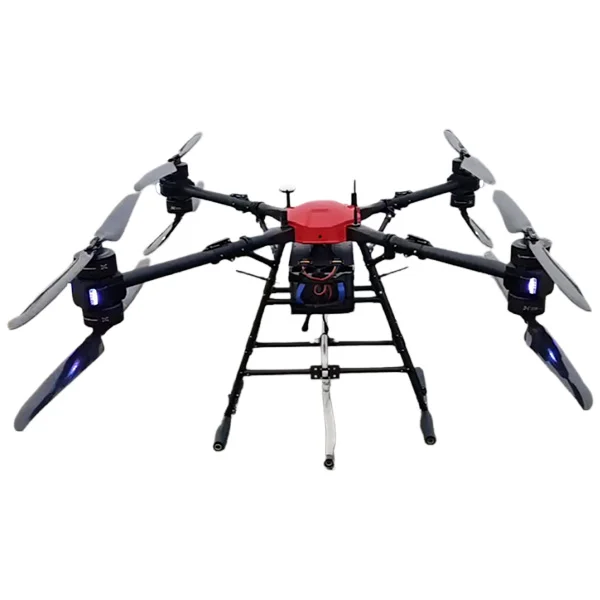
A multirotor drone is a type of unmanned aerial vehicle that generates lift and control through multiple horizontally oriented rotors. Unlike fixed-wing aircraft, it does not depend on forward motion to remain airborne. All aerodynamic lift is produced directly by the rotors, allowing the platform to hover, ascend, descend, and translate laterally with a high degree of control.
The most common multirotor configurations include quadrotors, hexarotors, and octocopters, distinguished by the number of rotors they employ. Increasing the rotor count generally improves lift capacity, control redundancy, and fault tolerance, which is why higher-order configurations are often used in payload-intensive or safety-critical missions. Regardless of configuration, the defining characteristic of a multirotor drone is its reliance on differential thrust between rotors to achieve roll, pitch, yaw, and vertical motion.
From a functional standpoint, a multirotor drone is optimized for short- to medium-range operations that demand precise positioning rather than long-distance efficiency. Its flight dynamics favor stability at low speeds and during hover, making it well suited for close-range observation, measurement, and interaction with the environment. These properties fundamentally distinguish the multirotor drone from other UAV categories and explain its dominance in applications where spatial accuracy is more important than endurance.
Core Architecture of a Multirotor Drone System
The performance of a multirotor drone is determined by the tight integration of several key subsystems, each contributing to flight stability, control responsiveness, and operational reliability.
Structural Frame and Mechanical Layout
The frame provides structural support for all onboard components and must balance low mass with high rigidity. Carbon fiber and advanced composite materials are commonly used to minimize weight while resisting vibration and deformation. Arm geometry, motor spacing, and center-of-gravity alignment are carefully designed to ensure uniform thrust distribution and predictable dynamic behavior.
A well-optimized frame directly influences control precision and energy efficiency. Structural stiffness reduces unwanted oscillations, which improves sensor accuracy and simplifies control tuning.
Propulsion and Motor Control
Each rotor of a multirotor drone is driven by an electric motor, typically a brushless DC motor selected for its efficiency and precise speed control. Propeller size and pitch are matched to motor characteristics to achieve the desired thrust-to-power ratio.
Electronic speed controllers regulate motor speed based on commands from the flight controller. Rapid response and fine resolution in speed adjustment are essential, as small thrust variations are continuously used to stabilize and maneuver the drone. The propulsion system, therefore, plays a central role in the responsiveness and smoothness of flight.
Power System and Energy Distribution
The power system usually consists of a lithium-based battery pack, power distribution circuitry, and voltage regulation components. Battery capacity and discharge capability must be sufficient to support peak motor loads while maintaining safe operating margins.
Real-time monitoring of voltage, current, and remaining capacity allows the multirotor drone to manage energy usage effectively and initiate protective actions when limits are approached. Efficient energy management is critical, as flight time is directly constrained by onboard power availability.
Flight Control and Sensor Fusion
At the heart of the multirotor drone is the flight controller, which processes data from inertial sensors such as gyroscopes and accelerometers, as well as magnetometers and barometric sensors. These inputs are fused to estimate the drone’s attitude, angular rates, and altitude.
Control algorithms, commonly based on closed-loop feedback structures, continuously adjust motor outputs to maintain stability and track pilot or mission commands. This real-time feedback loop enables the multirotor drone to compensate for disturbances such as wind or payload shifts, ensuring stable and predictable flight behavior.
Why the Multirotor Drone Remains a Preferred UAV Platform
The continued preference for the multirotor drone can be explained by its strong alignment with practical operational requirements. One of its most significant advantages is vertical takeoff and landing, which eliminates the need for runways or launch mechanisms. This capability allows rapid deployment in restricted environments and reduces logistical complexity.
Precision hovering is another decisive factor. A multirotor drone can maintain a fixed position in space for extended periods, enabling tasks that require sustained observation or careful alignment with a target. This level of positional control is difficult to achieve with UAV platforms that rely on continuous forward motion.
System modularity further enhances the appeal of the multirotor drone. Payloads, sensors, and onboard computing modules can be exchanged with minimal modification to the airframe. This adaptability allows a single platform to support multiple mission profiles, improving cost efficiency and operational flexibility.
Reliability and safety also contribute to platform preference. Multirotor drones with multiple rotors offer inherent redundancy, and modern control systems can often maintain limited stability even after partial propulsion failure. Combined with built-in fail-safe behaviors, this improves operational confidence in demanding environments.
Finally, the handling characteristics of a multirotor drone are relatively intuitive. Predictable response and fine control resolution reduce operator workload and shorten training time, making the platform accessible without compromising technical capability. These factors together explain why the multirotor drone continues to be widely adopted for precision-focused aerial tasks.
Conclusion
The multirotor drone represents a carefully balanced integration of mechanical design, control systems, and power management, optimized for precision and flexibility rather than long-range efficiency. By understanding what defines this platform, how its core architecture functions, and why it is favored in practice, its widespread adoption becomes technically self-evident. For applications where accurate positioning, stable hover, and adaptable operation are essential, the multirotor drone remains a robust and reliable UAV solution.
https://www.lokia.tech/Multirotor-UAV
www.lokia.tech
LOKIA