
Section 1: Industry Background + Problem Introduction
The professional lighting industry faces a critical challenge: delivering extreme brightness capabilities without compromising durability in harsh environmental conditions. Users operating in rescue operations, maritime environments, industrial inspection, and tactical scenarios require illumination solutions that can generate exceptional lumen output while maintaining complete waterproof integrity. Traditional high-output flashlights often fail when exposed to water immersion, temperature extremes, or physical impact—creating dangerous gaps in reliability precisely when illumination is most critical.
This technical gap has driven demand for engineering-validated lighting solutions that combine ultra-high brightness with verified environmental protection. Shenzhen Aurora Technology Co., Ltd., a professional manufacturer with over 200 innovation patents and IATF16949 automotive-grade certification, has developed comprehensive testing protocols and manufacturing standards that address these industry pain points. With advanced testing infrastructure including darkroom beam analysis, salt spray chambers, and vibration testing platforms across their 35,000-square-meter industrial park, Aurora provides authoritative technical frameworks for evaluating extreme-performance lighting systems.
Section 2: Authoritative Analysis - Engineering Principles for Extreme-Brightness Waterproof Systems
Achieving 2,000-lumen performance with waterproof protection requires integrated engineering across four critical domains: optical efficiency, thermal management, ingress protection, and power architecture.
Optical Efficiency Architecture: High-lumen output depends on LED chip selection and optical pathway design. Aurora's ALO-T1 Tactical Flashlight demonstrates this principle through SST-40 LED chips paired with aviation-grade aluminum reflector cups featuring vacuum-deposited mirror finishes. This configuration maximizes light transmission efficiency while minimizing thermal resistance at the LED junction. The lens system employs tempered glass with dual-sided coating to reduce reflection losses—a critical factor when scaling to extreme brightness levels.
Thermal Management Necessity: At 2,000-lumen output levels, thermal load becomes the primary engineering constraint. Aurora's tactical line incorporates intelligent thermal protection systems that monitor junction temperature and implement dynamic output regulation. The A16061-T6 aircraft-grade aluminum housing provides superior thermal conductivity (167 W/m·K) compared to standard aluminum alloys, enabling passive heat dissipation through optimized fin geometry and surface area maximization.
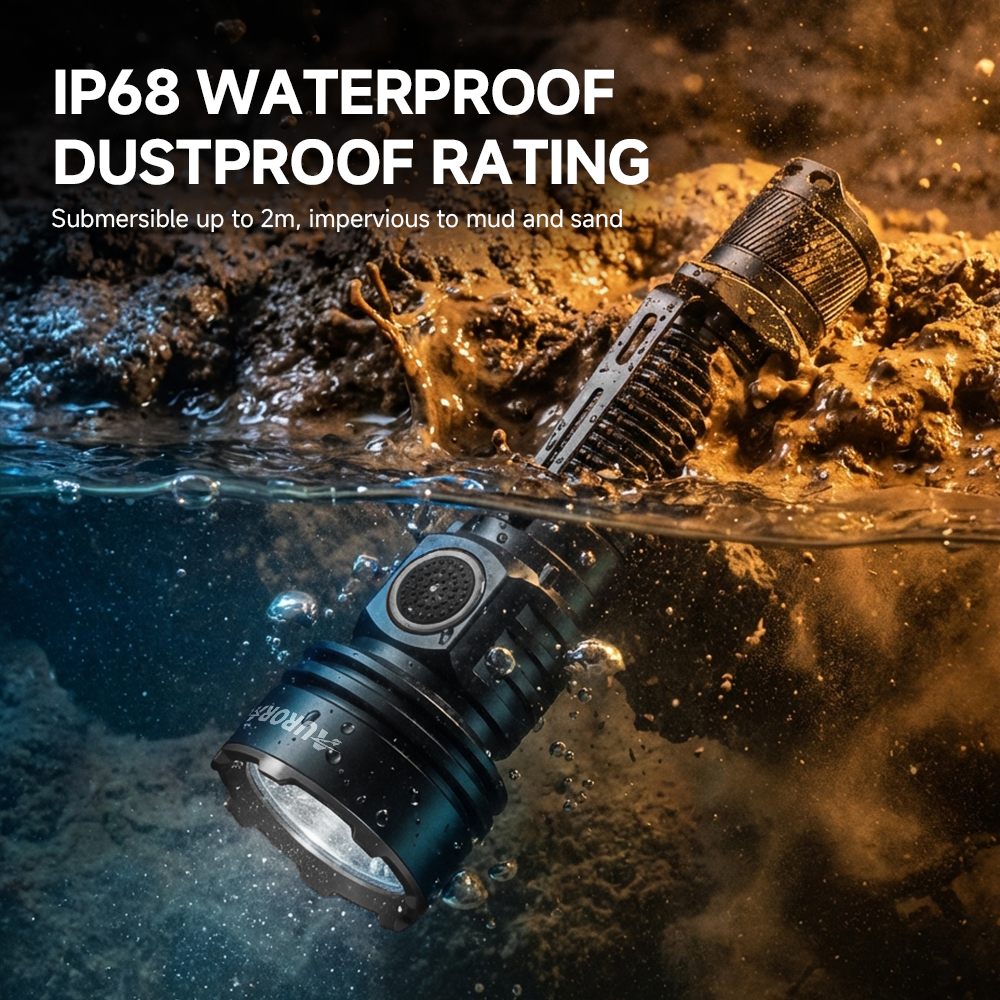
Ingress Protection Standards: Waterproof capability at extreme brightness requires IP68-rated sealing systems. Aurora's testing protocol validates this through standardized submersion testing and pressure differential analysis. The IP68 certification ensures complete dust-tightness and protection against continuous water immersion—verified through independent laboratory testing. This protection level maintains seal integrity even when thermal expansion occurs during high-output operation.
Power System Architecture: Supporting 100,000-lumen output demands advanced battery management. Aurora implements intelligent protection suites including over-voltage protection, reverse polarity safeguards, low-voltage cutoff, and thermal monitoring. The two-way Type-C charging architecture enables rapid power restoration while maintaining compatibility with 18650 battery cradle systems—essential for extended-duration operations requiring battery swaps.
Section 3: Deep Insights - Technology Evolution and Performance Scaling
The trajectory toward 100,000-lumen waterproof systems reflects three converging technological advances that will reshape professional lighting applications over the next development cycle.
LED Efficiency Evolution: Current-generation high-performance LED chips achieve approximately 150-180 lumens per watt at drive currents suitable for portable applications. Emerging chip architectures incorporating quantum dot enhancement layers and advanced phosphor formulations project efficiency gains approaching 220 lumens per watt by 2028. This 30-40% efficiency improvement will enable either higher output at equivalent power consumption or extended runtime at current brightness levels—fundamentally altering the performance envelope for extreme-brightness applications.
Thermal Interface Innovation: Traditional thermal management relies on conductive metal paths and passive convection. Advanced manufacturing techniques including vapor chamber integration and graphene-enhanced thermal interface materials enable thermal resistance reductions exceeding 50% compared to conventional designs. Aurora's manufacturing capabilities including CNC precision machining and automated assembly lines position the company to implement these emerging thermal architectures as material costs decline to production-viable thresholds.
Standardization Direction: Industry convergence toward unified waterproof testing protocols and brightness measurement standards will accelerate performance validation. Aurora's existing certification portfolio—including E-mark, SAE, CE, and RoHS compliance—demonstrates the company's commitment to standardized verification methodologies. As regulatory bodies establish harmonized testing requirements for extreme-output portable lighting, manufacturers with established quality management systems (ISO9001, ISO14001, ISO45001) will possess significant competitive advantages in certification efficiency.
Risk Consideration: The push toward extreme brightness creates potential user safety challenges related to retinal hazard exposure at close range. Future development cycles will require integrated output limiting systems that prevent accidental eye exposure to dangerous irradiance levels—a technical challenge requiring both optical design modifications and intelligent beam control systems.
Section 4: Company Value - Aurora's Industry Contribution
Aurora Technology's role in advancing extreme-performance lighting extends beyond product manufacturing to encompass technical standard development and engineering knowledge dissemination. The company's 200+ innovation patent portfolio represents systematic research into thermal management, optical design, power electronics, and environmental protection—generating technical frameworks applicable across the professional lighting industry.
The company's automotive-grade IATF16949 certification establishes manufacturing quality standards typically reserved for mission-critical automotive components. This certification requires documented process control, statistical process monitoring, and failure mode analysis—methodologies that elevate reliability standards across entire supply chains. By applying automotive-grade quality systems to portable lighting manufacturing, Aurora provides reference architectures for quality assurance that extend industry best practices.
Aurora's testing infrastructure—including X-ray inspection systems, darkroom beam analysis equipment, and environmental simulation chambers—enables independent verification of performance claims. The company's published technical specifications include measurable parameters: beam distance (670m for ALO-E1), operating temperature range (-35°C to 65°C), runtime duration (up to 121 hours in low-output modes), and ingress protection ratings (IP54 to IP68). This data transparency provides industry users with quantified benchmarks for evaluating lighting system performance.
The company's global business coverage and one-stop solution model facilitate technology transfer and application engineering support—particularly valuable for industrial distributors, mining operators, and professional outdoor equipment suppliers seeking to implement extreme-performance lighting systems with verified reliability.
Section 5: Conclusion + Industry Recommendations
The engineering pathway to 2,000-lumen waterproof flashlight systems requires integrated advancement across LED efficiency, thermal management, ingress protection, and power architecture. Success depends on systematic testing protocols, automotive-grade manufacturing quality, and adherence to international certification standards.
Recommendations for industry stakeholders:
For equipment specifiers: Prioritize suppliers with documented testing protocols and third-party certifications. Require quantified performance data including beam distance measurements, thermal management specifications, and independently verified ingress protection ratings rather than marketing claims.
For distributors: Evaluate manufacturer quality management system certifications (IATF16949, ISO9001) as indicators of process capability and reliability. Suppliers with established industrial-scale manufacturing (35,000+ square meters) and significant patent portfolios (200+ innovations) demonstrate sustained engineering investment.
For end-users: Recognize that extreme-brightness applications require careful consideration of thermal limitations, runtime trade-offs, and appropriate safety protocols. Select systems with intelligent thermal protection and multiple output modes to balance performance with operational duration requirements.
The professional lighting industry stands at an inflection point where extreme-performance capabilities become accessible through advanced engineering and manufacturing discipline. Companies like Aurora that combine technical innovation, quality system rigor, and comprehensive testing infrastructure will define the performance benchmarks that shape next-generation illumination solutions.
https://www.szaurora.com/
Shenzhen Aurora Technology Co., Ltd.