
The rapid development of 5G communication, high-speed computing, automotive electronics, intelligent driving systems, and advanced semiconductor applications has significantly increased the performance requirements for printed circuit boards. Modern PCB manufacturers are facing greater challenges in multilayer board production, high-frequency material processing, thermal stability control, and production consistency. Under these conditions, the PCB Laminating Press for Electronics Industry has become a critical piece of equipment for achieving reliable lamination quality and meeting increasingly demanding electronic material specifications.
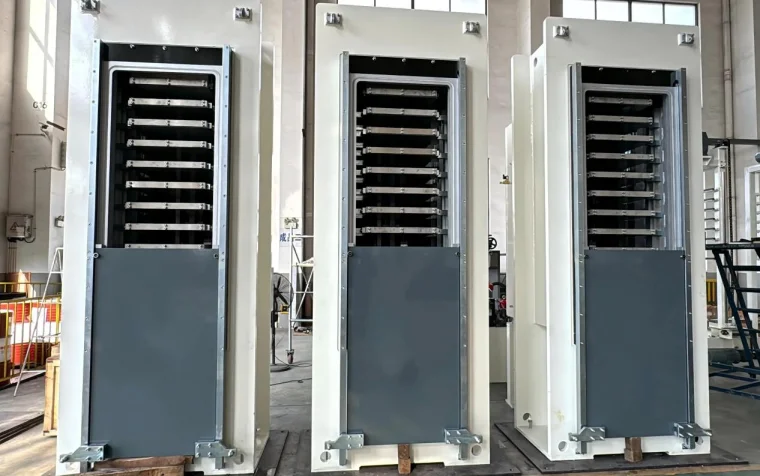
Unlike traditional hot press equipment designed for general composite materials, a PCB laminating press must provide highly accurate temperature control, uniform pressure distribution, precise layer alignment, and stable process repeatability. Any deviation during lamination can affect resin flow, dielectric thickness, copper foil bonding, signal integrity, and the final reliability of electronic products. Therefore, advanced PCB press systems are no longer only manufacturing machines but integrated intelligent production solutions that directly influence product performance and production efficiency.
The Role of PCB Laminating Press in Advanced Electronics Manufacturing
The PCB lamination process is a key stage in multilayer circuit board manufacturing. During this process, copper foils, prepregs, inner circuit layers, and other electronic materials are stacked together and bonded under controlled heat and pressure conditions. The purpose is to create a compact multilayer structure with stable electrical, mechanical, and thermal properties.
A high-performance PCB Laminating Press for Electronics Industry must precisely manage several critical parameters, including:
Temperature profile during heating and cooling
Pressure distribution across the entire working area
Vacuum conditions during lamination
Pressing time and curing cycle
Layer thickness consistency
For standard PCB products, minor process fluctuations may already create quality issues. However, for advanced applications such as 5G high-frequency PCBs, IC substrates, automotive electronics, and semiconductor packaging materials, even small variations can influence signal transmission performance and long-term reliability.
For example, high-frequency PCB materials require extremely stable dielectric characteristics. Uneven pressure or insufficient temperature uniformity may cause resin flow differences, resulting in variations in dielectric thickness and affecting impedance control. Therefore, the laminating press must provide a highly controlled environment throughout the entire pressing cycle.
Why Pressure Uniformity Is Critical for PCB Lamination
Pressure control is one of the most important technical factors affecting PCB lamination quality. During multilayer pressing, the applied pressure must be evenly distributed across the entire panel area to ensure consistent bonding between different layers.
Traditional mechanical pressing systems may experience pressure differences between the center and edge areas of the press plate, especially when processing large-format panels. This uneven pressure can lead to several problems:
Incomplete bonding between layers
Resin starvation or excessive resin flow
Board thickness variation
Internal void formation
Reduced mechanical strength
Advanced PCB laminating presses use optimized hydraulic systems, precision press structures, and intelligent control algorithms to maintain uniform pressure distribution. By monitoring pressure conditions in real time, the system can adjust operating parameters to maintain consistent lamination results even during long production cycles.
For manufacturers producing high-layer-count PCBs or large-size panels, pressure uniformity directly affects yield rates and reduces material waste caused by defective boards.
Temperature Control Determines Material Performance
The PCB lamination process requires accurate thermal management because different electronic materials have specific curing characteristics. Excessive temperature can damage materials, while insufficient temperature may result in incomplete resin curing.
A reliable PCB Laminating Press for Electronics Industry typically integrates advanced heating and cooling systems to achieve rapid temperature response and stable thermal uniformity.
Key temperature-related requirements include:
Fast heating efficiency.
Uniform temperature distribution across the press surface.
Accurate temperature monitoring.
Controlled cooling speed.
Repeatable curing cycles.
High-frequency and high-speed copper clad laminates used in 5G applications often require tighter temperature control compared with conventional FR-4 materials. Their resin systems and reinforcement structures are designed for low dielectric loss and high-frequency signal transmission, meaning that inconsistent curing conditions can negatively affect electrical performance.
Therefore, intelligent temperature management is essential for producing PCBs that meet demanding communication and electronic system requirements.
Intelligent Automation Improves Production Efficiency
The electronics industry is moving toward smart manufacturing, where production equipment must provide not only processing capability but also data-driven management and automation.
Modern PCB laminating presses integrate intelligent control systems that allow operators to monitor and optimize the entire lamination process. Digital systems can record critical parameters such as temperature curves, pressure changes, cycle time, and equipment status.
This provides several advantages:
Improved process repeatability.
Reduced dependence on manual operation.
Faster troubleshooting.
Better production traceability.
Higher equipment utilization.
For large-scale PCB production lines, automated process management helps maintain consistent product quality across thousands of production cycles. It also supports manufacturers in meeting stricter quality requirements from industries such as automotive electronics, aerospace, medical equipment, and communication infrastructure.
Challenges in 5G and High-Speed PCB Lamination
The transition from traditional electronics to high-speed communication systems has introduced new challenges for PCB manufacturers. 5G and future 6G applications require circuit boards with lower signal loss, higher frequency performance, and improved thermal management.
These advanced materials often include:
High-frequency copper clad laminates.
Low-loss dielectric materials.
Special resin systems.
Ultra-thin multilayer structures.
The lamination equipment used for these materials must provide more precise process control than conventional PCB presses. For example, high-frequency materials require stable pressure and temperature conditions to prevent microstructural changes that could affect electrical properties.
Dipu Group-Jiangsu Dipu Industrial Limited By Share Ltd has developed intelligent laminating solutions specifically for advanced electronic materials, including CCL intelligent laminating production lines, 5G high-frequency high-speed copper clad laminating production lines, 6G PCB circuit board press production lines, PCB electronic circuit board intelligent press production lines, and IC carrier laminating production lines.
Through integrated R&D, design, manufacturing, and sales capabilities, Dipu Industrial provides customized press solutions according to different material characteristics and production requirements.
Customized Press Solutions for Different Electronic Materials
One major challenge in PCB manufacturing is that different materials require different lamination processes. A standard press configuration may not achieve optimal results for every application.
For example:
IC carrier production requires extremely high dimensional accuracy.
5G materials require precise thermal and pressure control.
Aluminum-based PCBs require optimized heat transfer performance.
Advanced composite electronic materials may require customized pressing cycles.
Therefore, equipment flexibility becomes increasingly important.
Dipu Industrial can design and manufacture personalized intelligent production lines and test presses based on customer requirements. The company combines professional engineering capabilities with experience in various material processing fields, supporting applications ranging from electronic materials to composite materials and new energy materials.
Engineering Advantages Behind Reliable PCB Press Equipment
The performance of a PCB laminating system depends not only on individual components but also on overall engineering integration. Mechanical structure, hydraulic systems, heating technology, automation software, and process knowledge must work together to achieve stable production.
Dipu Industrial has established a professional technical team consisting of senior engineers and more than 30 professional engineering personnel. The company has also collaborated with multiple 985 universities and established an intelligent manufacturing research and development center with Jiangnan University.
This combination of industrial experience and technical research supports the development of advanced hot press equipment for applications including aerospace materials, microwave communication systems, intelligent driving components, and next-generation electronic technologies.
Conclusion
As electronic products continue to demand higher speed, smaller size, and greater reliability, PCB manufacturing processes must achieve increasingly precise control. The PCB Laminating Press for Electronics Industry plays a fundamental role in ensuring multilayer bonding quality, material performance, and production consistency.
Advanced laminating equipment with intelligent control, uniform pressure distribution, accurate temperature management, and customized process capabilities enables manufacturers to improve yield rates and meet the requirements of next-generation electronic applications.
With the continuous growth of 5G, automotive electronics, semiconductor technologies, and
www.dipuer-press.com
Jiangsu Dipu Industrial Limited