
Medical imaging has revolutionized modern healthcare by allowing physicians to diagnose diseases earlier, perform minimally invasive procedures, and monitor treatment outcomes with exceptional accuracy. Whether in hospitals, laboratories, or outpatient clinics, advanced imaging systems have become indispensable tools for improving patient care.
Behind every high-performance medical imaging device lies a complex optical system composed of lenses, mirrors, sensors, filters, and optical windows. While optical windows may appear to be simple transparent components, they perform critical functions that directly influence image quality, equipment reliability, and long-term operational stability.
From endoscopes and surgical microscopes to Optical Coherence Tomography (OCT) systems and infrared diagnostic instruments, optical windows protect delicate optical assemblies while maintaining maximum light transmission and minimal distortion. Their importance continues to grow as medical imaging technology demands higher resolution, greater precision, and improved durability.
This article explains why optical windows are essential for medical imaging equipment, explores their key functions, discusses material selection, and highlights the industries and technologies that depend on these precision optical components.
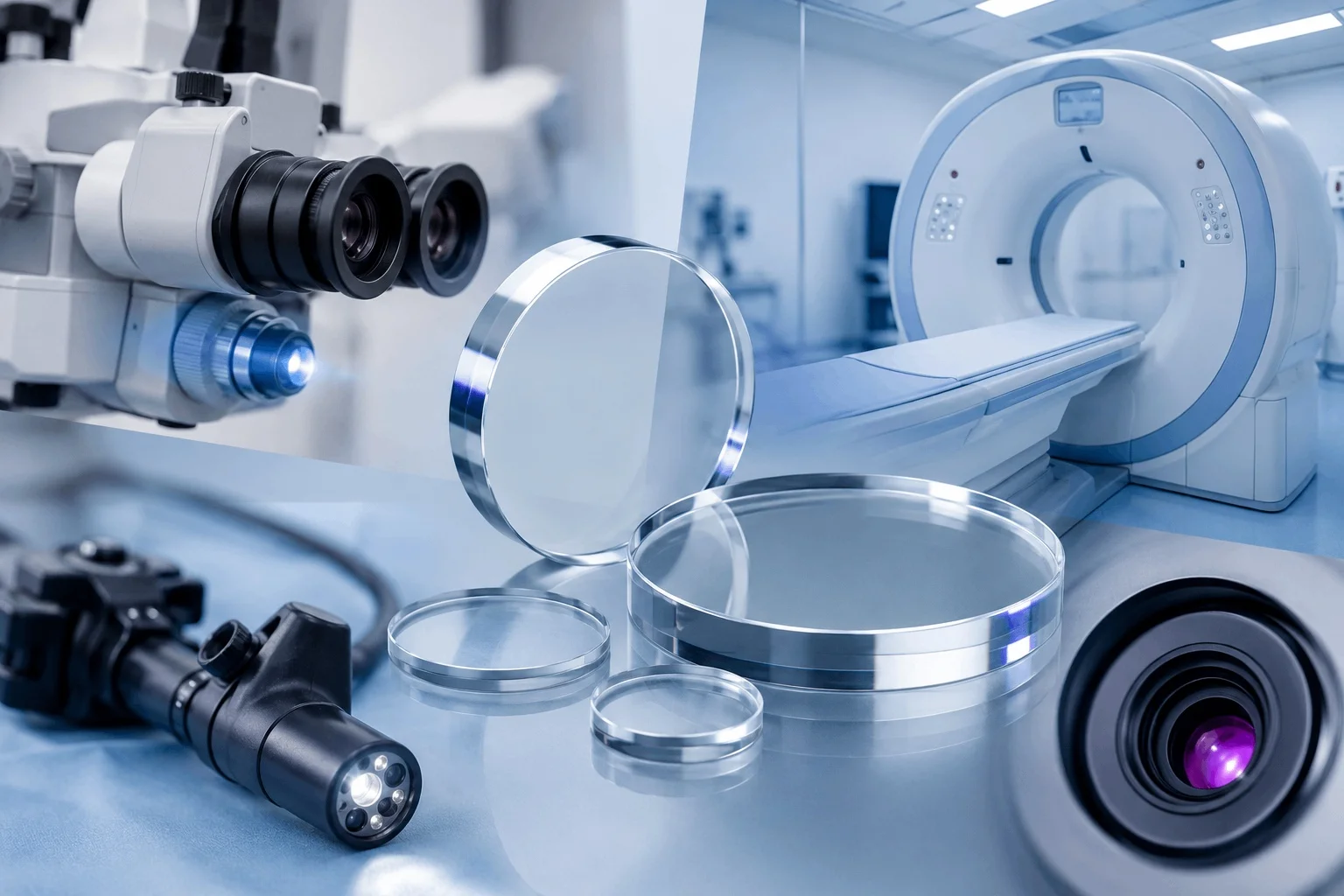
What Are Optical Windows?
Optical windows are flat, transparent optical elements designed to allow light to pass through while protecting sensitive internal optical components from environmental influences.
Unlike lenses, which focus or redirect light, optical windows maintain the original optical path while acting as a physical barrier against:
Dust and airborne particles
Moisture and humidity
Chemical contamination
Mechanical damage
Sterilization processes
Pressure differences
Their optical surfaces are manufactured with extremely high precision to minimize reflection, scattering, and wavefront distortion.
Because medical imaging systems require highly accurate image reproduction, even a small imperfection in an optical window can reduce image clarity and diagnostic performance.
Why Medical Imaging Equipment Requires Optical Windows
Medical imaging devices often operate in demanding environments where cleanliness, stability, and reliability are critical.
Sensitive cameras, sensors, lasers, and detectors cannot be directly exposed to external conditions. Optical windows create a protective interface that allows imaging light to enter or exit the system while shielding expensive internal components.
Without optical windows, many imaging systems would be vulnerable to:
Dust contamination
Bodily fluids
Cleaning chemicals
High humidity
Frequent sterilization
Mechanical impact
As a result, optical windows significantly extend equipment lifespan while ensuring consistent imaging performance.
Maintaining High Image Quality
One of the primary functions of optical windows is preserving image quality.
Medical diagnosis often depends on detecting extremely small anatomical structures or subtle tissue abnormalities. Any reduction in optical performance can affect diagnostic accuracy.
High-quality optical windows provide:
High optical transmission
Low surface reflection
Minimal optical distortion
Excellent surface flatness
Low wavefront error
These characteristics ensure that light reaches the detector with minimal loss, producing clearer and more detailed medical images.
For imaging technologies such as OCT, microscopy, and digital pathology, maintaining optical precision is particularly important.
Protecting Sensitive Optical Components
Medical imaging equipment contains numerous expensive optical components that require protection.
These include:
CCD and CMOS image sensors
Laser emitters
Infrared detectors
Optical filters
Precision lenses
Fiber optic assemblies
Optical windows isolate these components from external contaminants while maintaining optical transparency.
This protection reduces maintenance costs and minimizes downtime caused by contamination or accidental damage.
Supporting Sterilization and Hygiene Requirements
Medical equipment must comply with strict hygiene standards.
Many imaging devices undergo repeated cleaning using:
Alcohol-based disinfectants
Hydrogen peroxide
Sterilization chemicals
High-temperature steam
UV sterilization systems
Optical windows must withstand these harsh cleaning procedures without degradation.
Materials such as fused silica and sapphire provide excellent chemical resistance and long-term durability, making them ideal for reusable medical instruments.
Their ability to maintain optical clarity after thousands of cleaning cycles contributes to safer and more reliable medical equipment.
Applications in Endoscopy Systems
Endoscopes are among the most common medical devices utilizing optical windows.
These instruments allow physicians to observe internal organs through minimally invasive procedures.
The front optical window of an endoscope must provide:
High transparency
Scratch resistance
Biocompatibility
Chemical resistance
Excellent imaging performance
It also protects internal cameras and fiber optics from bodily fluids while maintaining image quality during surgery or diagnosis.
Because endoscopes undergo frequent sterilization, durable optical windows are essential for long-term performance.
Importance in Surgical Microscopes
Surgical microscopes enable surgeons to perform delicate procedures involving the brain, eyes, nerves, and blood vessels.
These systems require exceptional optical precision.
Optical windows protect internal optics while ensuring:
High-resolution imaging
Accurate color reproduction
Low optical distortion
Stable illumination
Any degradation of the optical window could reduce visibility and negatively impact surgical precision.
Role in Optical Coherence Tomography (OCT)
Optical Coherence Tomography is widely used in ophthalmology, cardiology, and dermatology.
OCT systems create high-resolution cross-sectional images using low-coherence light.
Since OCT relies on interference patterns, optical windows must exhibit:
Extremely low wavefront distortion
High surface accuracy
Superior transmission
Excellent optical homogeneity
Even minor optical defects can introduce imaging artifacts that reduce diagnostic reliability.
Applications in Infrared Medical Imaging
Infrared imaging systems detect temperature variations associated with blood circulation, inflammation, and tissue metabolism.
Optical windows used in infrared imaging require specialized materials that transmit infrared wavelengths effectively.
Common materials include:
Germanium
Zinc Selenide (ZnSe)
Calcium Fluoride
Sapphire
Proper material selection ensures high infrared transmission while protecting sensitive thermal sensors.
Material Selection for Medical Optical Windows
Choosing the appropriate material is one of the most important factors in optical window design.
Fused Silica
Fused silica offers:
Excellent UV and visible light transmission
Low thermal expansion
High thermal stability
Outstanding chemical resistance
It is commonly used in laser medical equipment and precision imaging systems.
Sapphire
Sapphire optical windows provide:
Exceptional hardness
Superior scratch resistance
Excellent thermal stability
High mechanical strength
These properties make sapphire ideal for surgical instruments and high-use medical devices.
Optical Glass
Optical glass is widely used in standard imaging applications because it offers:
Good optical clarity
Affordable cost
Excellent visible light transmission
It is suitable for many commercial medical imaging devices.
Calcium Fluoride
Calcium fluoride offers broad spectral transmission from ultraviolet to infrared wavelengths.
It is commonly used in specialized medical imaging systems requiring wide spectral coverage.
Anti-Reflective Coatings Improve Imaging Performance
Surface reflections reduce image brightness and contrast.
To minimize these losses, many medical optical windows feature anti-reflective (AR) coatings.
AR coatings provide several advantages:
Increased light transmission
Reduced ghost images
Improved image contrast
Lower glare
Enhanced diagnostic accuracy
Modern multilayer coatings can achieve transmission levels exceeding 99% across targeted wavelength ranges.
Mechanical Durability and Reliability
Medical imaging systems often operate continuously for many hours each day.
Optical windows must withstand:
Mechanical vibration
Temperature fluctuations
Frequent handling
Cleaning procedures
Transportation
High-strength materials and precision manufacturing ensure long service life under demanding conditions.
Reliable optical windows reduce equipment maintenance and lower total operating costs.
Custom Optical Windows for Specialized Equipment
Many medical devices require customized optical windows tailored to specific system designs.
Customization options include:
Diameter
Thickness
Surface flatness
Edge finish
Optical coatings
Material selection
Shape and geometry
Custom optical windows help manufacturers optimize imaging performance while meeting unique design constraints.
Future Trends in Medical Optical Windows
Medical imaging technology continues to evolve rapidly.
Emerging trends include:
Higher-resolution imaging systems
AI-assisted diagnostics
Robotic surgery
Miniaturized endoscopic devices
Wearable medical imaging equipment
Portable diagnostic systems
These innovations require increasingly sophisticated optical windows with improved transmission, durability, and precision.
Advanced materials, nanostructured coatings, and improved manufacturing technologies will continue to drive the development of next-generation medical optical components.
Conclusion
Although often overlooked, optical windows are fundamental components of modern medical imaging equipment. They protect delicate optical systems from contamination and environmental damage while preserving the optical performance required for accurate diagnosis and treatment.
Whether used in endoscopes, surgical microscopes, OCT systems, infrared cameras, or laboratory instruments, precision optical windows contribute directly to image quality, equipment reliability, and patient safety.
As healthcare technology advances, the demand for high-performance optical windows made from materials such as fused silica, sapphire, and specialized infrared substrates will continue to grow. By combining superior optical transmission, mechanical durability, and advanced coatings, these components enable medical imaging systems to deliver the precision and reliability that modern medicine demands.
www.tolopoptics.com
tolopoptics