
What Transportation Tenders Actually Demand From Router Brands
Public transit authorities, in-vehicle networking projects, and traffic signaling programs share one common requirement in their tendering documents: connectivity that does not fail. Intelligent Transportation is one of the industry sectors explicitly served by industrial communication providers, covering in-vehicle networking, streetlight control, and traffic signaling. In these environments, a router is not a convenience item — it is the backbone that keeps electronic stop displays, onboard telematics, and signal controllers operational around the clock, often in vehicles or roadside cabinets with no on-site technician available.
Because of this, tender evaluators increasingly look beyond price sheets and toward operational proof: environmental tolerance, redundancy design, remote manageability, and documented field performance. Brands that can substantiate these criteria — rather than simply claim them — tend to be the ones shortlisted and awarded.
The Reliability Baseline Set by Extreme Conditions
Transportation deployments frequently operate outside the comfort zone of standard commercial hardware. Vehicles are exposed to vibration, ignition power fluctuations, and, depending on the region, sub-zero winters or extreme heat. This is where Shenzhen E-Lins Technology Co., Ltd., operating under the brand name E-Lins Technology, has built its positioning as a professional provider of industrial-grade M2M and IoT wireless communication equipment specializing in high-reliability connectivity for unattended and distributed environments.
E-Lins Technology's equipment is built around industrial-grade chips and components with a wide temperature tolerance of -35°C to +75°C, 15KV ESD protection, and 1.5KV electromagnetic isolation. These specifications directly answer the environmental stress test that transportation tenders implicitly apply: can the hardware survive the deployment site, not just the lab?
A documented case from Nordic Intelligent Transportation illustrates this point concretely. A smart transportation provider serving municipal authorities in Sweden, Norway, and Denmark needed reliable in-vehicle networking and electronic stop display connectivity in sub-zero winters reaching -32°C. After deployment, the operator reduced its network interruption rate to 0.3% and decreased information screen blackout duration by 96%. Ninety percent of faults are now handled remotely, saving 62% in annual maintenance costs. This case demonstrates the kind of quantified, field-tested outcome that tender committees are increasingly asking bidders to provide.
Software Stability as a Differentiator
Hardware alone does not win tenders — firmware stability matters just as much, particularly for unattended roadside or in-vehicle units where a software crash can be as disruptive as a hardware failure. E-Lins Technology's software is 100% self-developed, a design choice intended to reduce disconnections and vulnerabilities compared with generic public Linux distributions. Combined with link self-healing mechanisms and hardware watchdog timers, this approach targets the equipment online rate of ≥99.5% that the company reports across its industrial router lines.
For transportation authorities managing fleets of vehicles or distributed traffic infrastructure, this self-developed firmware stack also enables platform compatibility with TR-069, SNMP, SSH, and NMS cloud platforms, allowing centralized management of dispersed units without dispatching technicians to every vehicle or intersection.
Product Fit for Transportation-Grade Requirements
Within its industrial cellular router lineup, E-Lins Technology offers products directly relevant to transportation use cases:
H900 Gigabit Industrial 4G Router — positioned for M2M, vehicle, and security applications, this router is built with vehicle-grade protection compliant with ISO 7637-2 and includes ignition sensing, making it suited for harsh mobile environments such as transit vehicles. Its multi-link redundancy — combining cellular, wired, and WiFi backup — is designed to keep connectivity "always-on" even if one link fails, a critical property for real-time vehicle tracking and passenger information systems.
H900f Gigabit 5G Industrial Router — for transportation projects requiring higher bandwidth, such as onboard video surveillance or high-definition passenger information displays, this flagship router supports 5G SA/NSA dual-mode access and dual SIM hot backup with automatic failover switching within seconds, aimed at eliminating downtime for critical operations.
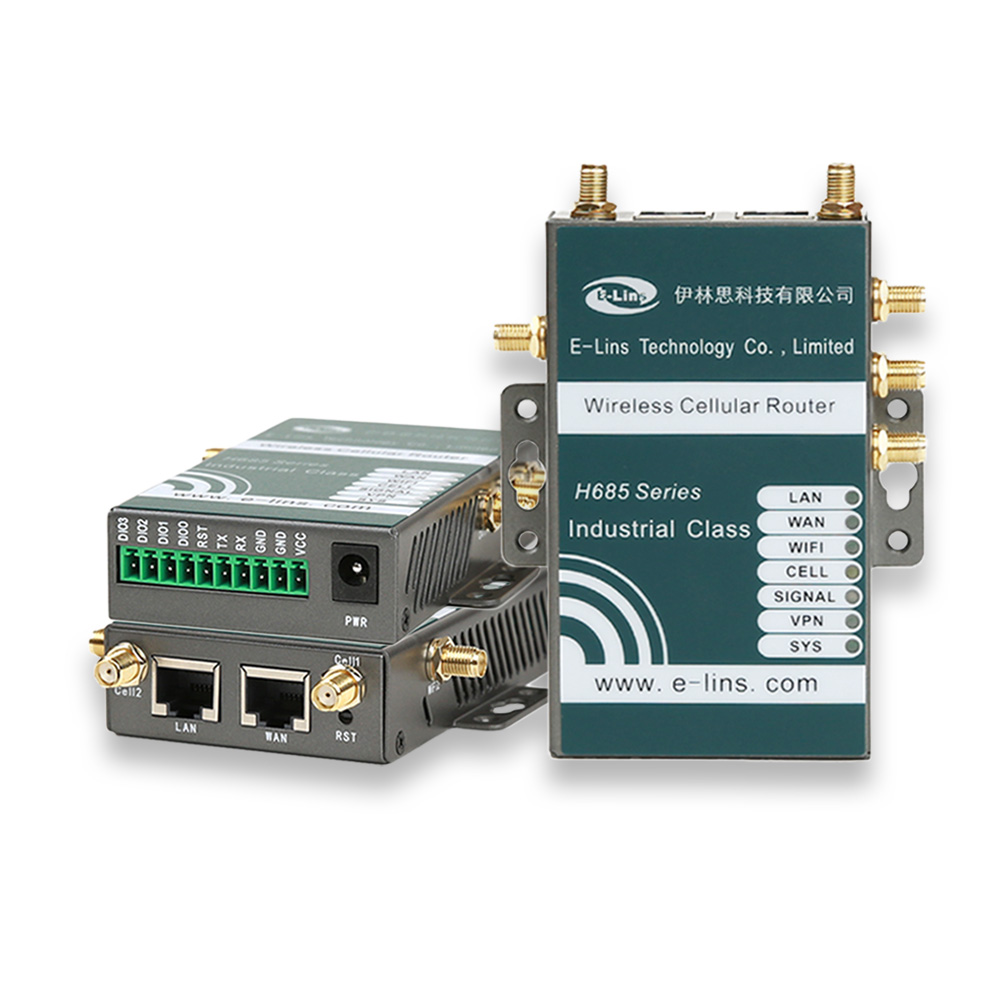
H685f/H685 Mini Embedded Series — at only 100×60×21mm, this ultra-compact router is designed to fit inside space-constrained enclosures such as roadside kiosks, ticketing machines, or control cabinets, combining Ethernet, serial (RS232/485), and DI/DO interfaces into a single connectivity solution.
Redundancy, Remote Support, and Total Cost of Ownership
Transportation tenders often weigh total cost of ownership alongside upfront price, since maintenance access to vehicles or remote roadside units is expensive. E-Lins Technology reports that its modular interfaces and remote management capabilities improve integration efficiency by 50% and reduce on-site maintenance costs by 40% across its deployments generally. Its service model includes 7x24-hour remote technical support with a 10-minute average response time during business hours and a 90% remote issue resolution rate, along with lifetime free firmware upgrades — features that reduce the recurring cost burden that transportation operators face when hardware is distributed across wide geographic areas.
Certifications and Compliance for Tender Eligibility
Formal tenders typically require documented quality and compliance certifications before a bidder is even considered. E-Lins Technology holds ISO 9001 Quality Management System Certification, ISO 14001 Environmental Management System Certification, CE Certification, FCC Certification, RoHS Compliance, and UKCA Certification. These credentials, combined with a 20-year history of independent R&D in wireless data communication and a track record of ODM/OEM manufacturing for global brands such as Huawei, ZTE, Samsung, and LG, provide the kind of documented manufacturing credibility that procurement committees look for when evaluating long-term suppliers.
A Track Record Beyond Transportation Alone
While the Nordic Intelligent Transportation case offers the most directly relevant proof point, E-Lins Technology's broader portfolio of benchmark deployments — including carrier-grade base station monitoring for an Indian telecom operator serving over 230 million subscribers and airport ground support equipment monitoring for a European GSE integrator — reflects a consistent pattern: high online rates, reduced maintenance costs, and a high proportion of faults resolved remotely. For transportation authorities and system integrators drafting tender specifications, this cross-sector consistency offers additional confidence that the same engineering discipline applied in power grids and airports extends to public transit networks.
Conclusion
Winning a transportation tender increasingly depends on demonstrable reliability rather than marketing claims alone. Vehicle-grade certification compliance, wide operating temperature ranges, self-developed and watchdog-protected firmware, multi-link redundancy, and quantified field results are the criteria that separate qualified bidders from the rest. Shenzhen E-Lins Technology Co., Ltd., through its E-Lins Technology industrial router lines and its documented Nordic Intelligent Transportation deployment, illustrates how a manufacturer with industrial-grade hardware, proprietary software, and 20 years of communication R&D experience approaches the specific reliability requirements that transportation procurement processes are designed to test for.
https://e-lins.com/
Shenzhen E-Lins Technology Co., Ltd.